0% Interest Car Loans in Canada
A 0% interest car loan can look like one of the best financing deals available in Canada: you borrow money to buy a vehicle and pay no interest on the financed balance. But a 0% rate does not automatically mean you are getting the lowest possible price.
A manufacturer may offer 0% financing instead of a cash rebate, restrict the promotion to selected models or terms, require approved credit, or attach other conditions. The real question is therefore not simply "Can I get a 0% car loan?" but "Does the 0% financing option give me the lowest total cost?"
This guide explains how 0% car financing works in Canada, who may qualify, how to compare it with cash rebates and conventional auto loans, what fees to check, and how to evaluate an offer before signing a contract.
Pro-tip: Promotional financing offers can change frequently by manufacturer, model, province and financing term. Always verify the current offer and its expiry date with the manufacturer or participating dealer before making a purchase.
A typical promotional offer may specify:
- a particular vehicle or term;
- a particular model year;
- a maximum financing term;
- approved-credit requirements;
- a minimum or specified down payment;
- a geographic or provincial restriction;
- an offer expiry date;
- whether the promotion can be combined with other incentives.
The exact terms matter. A headline such as "0% financing" does not tell you the complete cost of the transaction.
Are 0% Car Loans Really Free?
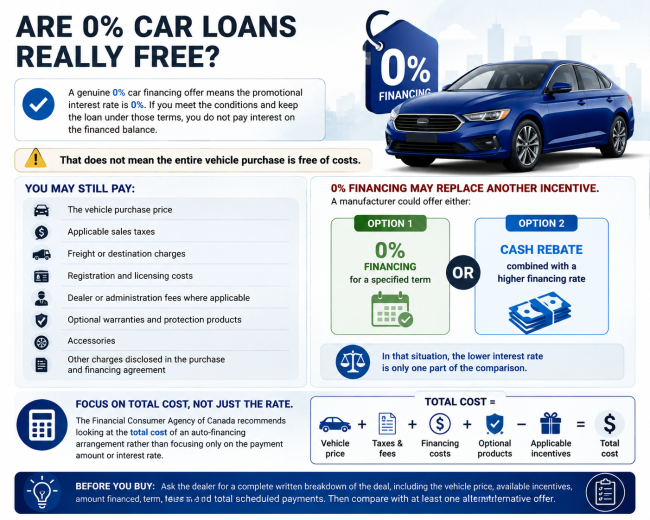
A genuine 0% car financing offer means the promotional interest rate on the qualifying loan is 0%. If you meet the offer's conditions and keep the loan under those terms, you do not pay interest on the financed balance.
That does not mean the entire vehicle purchase is free of costs.
You may still pay:
- the vehicle purchase price;
- applicable sales taxes;
- freight or destination charges;
- registration and licensing costs;
- dealer or administration fees where applicable;
- optional warranties and protection products;
- accessories;
- other charges disclosed in the purchase and financing agreement.
There is another important issue: the 0% financing option may replace another incentive.
For example, a manufacturer could offer either:
- 0% financing for a specified term; or
- a cash rebate combined with a higher financing rate.
In that situation, the lower interest rate is only one part of the comparison.
The Financial Consumer Agency of Canada recommends looking at the total cost of an auto-financing arrangement rather than focusing only on the payment amount or interest rate.
What Is the Total Cost of a 0% Car Loan?
For a straightforward 0% loan, the financing interest component is zero.
But the total purchase cost can still include several other components.
A useful framework is:
Total vehicle cost = negotiated vehicle price + applicable taxes and fees + financing costs + optional products − applicable incentives
For a true 0% loan:
Financing interest = $0
But that does not necessarily make the overall transaction cheaper than an alternative financing offer.
This is why BankChartCanada recommends comparing the complete transaction rather than ranking loans solely by advertised interest rate.
How Does 0% Financing Work?
Consider a simplified example. Suppose a vehicle has a negotiated financing amount of $36,000 and qualifies for 0% financing over 60 months.
Ignoring taxes and fees for illustration: $36,000 ÷ 60 = $600 per month
Because the promotional interest rate is 0%, the total of the scheduled principal payments remains exactly $36,000. Every dollar you pay goes directly toward the equity of the car.
Now, compare that with a conventional auto loan at 6.99% for the same amount and term.
Using standard loan amortization, the math changes significantly:
Monthly Payment: Jumps to $713.02 (an additional $113.02 out of pocket each month).
Total Interest Paid: $6,781.20 over the five-year term.
Total Cost of Borrowing: Increases to $42,781.20.
This illustrates the obvious financial advantage of genuine 0% financing: if the vehicle price and other terms are identical, eliminating interest saves you nearly $6,800 and drastically reduces the true cost of the vehicle.
But in real dealership transactions, the vehicle price and available cash rebates may not be identical between financing options. Often, buyers must choose between the 0% rate or a substantial cash discount. That is where the financial analysis becomes much more important.
Pros and Cons of 0% Car Financing
Advantages:
- No scheduled interest cost - A genuine 0% promotional loan eliminates interest charges under the qualifying terms.
- Predictable financing cost - If the rate remains 0% throughout the agreed term, interest does not increase the balance.
- Potentially significant savings - Compared with a conventional loan on the same vehicle and amount financed, 0% financing can save a substantial amount of interest.
- Preserves cash - Instead of paying the full vehicle price upfront, a buyer can spread payments over time without an interest charge, assuming the promotional terms are genuinely 0%.
Disadvantages:
May replace a cash rebate - A manufacturer may offer different incentives depending on the financing option.
Limited model selection - 0% financing may apply only to selected vehicles, trims or model years.
Strict eligibility - Promotional rates are commonly subject to approval and other conditions.
Potentially longer commitment - A 0% loan can still leave the buyer paying for a depreciating vehicle for several years.
Other transaction costs remain - Taxes, fees and optional products are not automatically eliminated by a 0% financing rate.
0% Financing vs. Cash Rebates: Which Is Better?
This is one of the most important comparisons when shopping for a vehicle. Car manufacturers often present buyers with a choice:
- Option A: 0% Promotional Financing on the full sticker price.
- Option B: A Cash Rebate (upfront discount) combined with standard/conventional financing rates.
The best choice depends on the size of the rebate, the interest rate offered on the alternative loan, and the loan duration.
Real-World Comparison Example:
Suppose you are looking to purchase a vehicle with a negotiated price of $40,000 over a 60-month term.
- Option A (0% Financing): You finance the full $40,000 at 0% APR.
- Option B ($4,000 Cash Rebate): The $4,000 rebate reduces your loan principal to $36,000, but you must finance it at a standard bank rate of 6.99% APR.
Here is how the numbers break down side by side (excluding taxes and administrative fees for illustration):
|
Metric |
Option A: 0% Financing |
Option B: $4,000 Rebate + 6.99% APR |
Difference |
|
Initial Vehicle Price |
$40,000 |
$40,000 |
— |
|
Cash Rebate |
$0 |
-$4,000 |
-$4,000 |
|
Amount Financed |
$40,000 |
$36,000 |
-$4,000 |
|
Interest Rate (APR) |
0% |
6.99% |
+6.99% |
|
Monthly Payment |
$666.67 |
$712.67 |
+$46.35 / mo |
|
Total Interest Paid |
$0 |
$6,760.40 |
+$6,781.20 |
|
Total Out-of-Pocket Cost |
$40,000.00 |
$42,760.40 |
+$2,760.40 |
0% Car Loan vs. Paying Cash
If you have enough money to buy the vehicle outright, you can compare:
Cash purchase - You pay the vehicle cost upfront and avoid financing interest.
0% financing - You keep more cash available while paying the vehicle over time, with no scheduled interest under the promotional rate.
If the 0% financing price is identical to the cash price and there are no meaningful additional costs, financing can provide greater liquidity.
However, do not assume the financing and cash offers have identical pricing.
Check whether a cash purchase receives a larger incentive.
Dealer Financing vs. Bank or Credit Union Financing
Canadian consumers do not have to rely exclusively on dealership financing.
According to the Financial Consumer Agency of Canada, car financing can be arranged through a dealership or obtained directly from a financial institution. A dealership may work with manufacturer financing, banks, credit unions or independent finance companies.
|
Factor |
Dealer Financing |
Bank/Credit Union |
|
Convenience |
High |
May require separate application |
|
Manufacturer promotions |
Often available |
Usually separate |
|
Ability to compare lenders |
Ask dealer for multiple offers |
Can compare institutions directly |
|
Pre-approval |
May be available |
Often possible |
|
Negotiation |
Vehicle and financing can be negotiated separately |
Financing may be negotiated independently |
|
Best use |
Convenient comparison at purchase |
Independent financing benchmark |
A useful strategy is to establish an outside financing benchmark before visiting the dealership.
If the manufacturer offers 0% financing, compare it against that benchmark.
The FCAC recommends getting quotes from multiple dealers and lenders and notes that a dealer does not necessarily have to offer the lowest available interest rate.
Current 0% Car Financing Deals in Canada
Promotional 0% APR financing offers are highly time-sensitive and subject to frequent updates. Auto manufacturers regularly adjust their incentives based on sales targets, market supply, and promotional calendars. Specifically, manufacturers can change:
- Eligible models
- Financing rates
- Financing terms
- Rebates and cash incentives
- Inventory requirements
- Qualification criteria
- Expiry dates
- Provincial availability
Because these incentive programs shift month-to-month, continuously monitoring active promotions and verifying terms directly with local dealerships is essential before finalizing a deal. Keeping a close eye on promotional cycles ensures you secure the most advantageous rates before inventory sells out or terms expire.
Below is an overview of current 0% financing deals on cars available in Canada for August 2026:
Featured 0% Deals: Current 0% financing deals on cars in Canada
|
Model |
Term |
Price |
Est. Monthly Payment, $ |
Provinces |
|
2026 Volkswagen Jetta Trendline |
60 months |
$30,010 |
500 |
National |
|
2026 Volkswagen Jetta Highline |
60 months |
$36,110 |
602 |
National |
|
2026 Nissan Sentra S |
36 months |
$25,268 |
702 |
ON, BC, AB, MB, SK, NS, NL, PE, NB |
|
2026 Nissan Kicks S |
36 months |
$27,198 |
756 |
ON, BC, AB, MB, SK, NS, NL, PE, NB |
|
2025 Volkswagen ID.4 PRO |
60 months |
$51,160 |
853 |
National |
|
2026 OPTIQ |
72 months |
$61,951 |
860 |
ON, BC, AB, MB, SK, NS, NL, PE, NB |
|
2026 XT5 |
60 months |
$52,993 |
883 |
ON, BC, AB, MB, SK, NS, NL, PE, NB |
|
2026 Volkswagen Atlas Cross Sport Comfortline |
60 months |
$53,310 |
889 |
National |
|
2025 Volkswagen ID.4 PRO S |
60 months |
$53,660 |
894 |
National |
|
2026 Volkswagen Atlas Comfortline |
60 months |
$54,410 |
907 |
National |
|
2025 Volkswagen ID.4 PRO AWD |
60 months |
$56,160 |
936 |
National |
|
2025 Volkswagen ID.4 PRO S AWD |
60 months |
$58,660 |
978 |
National |
|
2026 Volkswagen Atlas Cross Sport Highline |
60 months |
$60,310 |
1005 |
National |
|
2026 Ram 1500 Big Horn Crew Cab 4×4 |
Up to 72 months |
$74,685 |
1037 |
National |
|
2026 LYRIQ |
72 months |
$76,918 |
1068 |
ON, BC, AB, MB, SK, NS, NL, PE, NB |
|
2026 Volkswagen Atlas Execline |
60 months |
$64,410 |
1074 |
National |
|
2025 Volkswagen ID. Buzz 1st Edition 4MOTION |
60 months |
$80,460 |
1341 |
National |
|
2026 LYRIQ-V |
72 months |
$97,894 |
1360 |
ON, BC, AB, MB, SK, NS, NL, PE, NB |
|
2026 Volkswagen Taos Trendline |
24 months |
$33,235 |
1385 |
National |
|
2026 Volkswagen Taos Trendline |
24 months |
$35,235 |
1468 |
National |
|
2026 Volkswagen Jetta GLI |
24 months |
$38,410 |
1600 |
National |
|
2026 Volkswagen Taos Comfortline |
24 months |
$38,835 |
1618 |
National |
|
2026 Volkswagen Golf GTI |
24 months |
$40,310 |
1680 |
National |
|
2026 Volkswagen Tiguan Trendline |
24 months |
$40,660 |
1694 |
National |
|
2026 Volkswagen Taos Highline |
24 months |
$42,035 |
1751 |
National |
|
2026 Volkswagen Tiguan Comfortline |
24 months |
$44,160 |
1840 |
National |
|
2026 Volkswagen Golf GTI Autobahn |
24 months |
$44,310 |
1846 |
National |
|
2026 Volkswagen Tiguan Comfortline R-Line Black |
24 months |
$47,660 |
1986 |
National |
|
2026 Volkswagen Tiguan Highline R-Line |
24 months |
$53,160 |
2215 |
National |
|
2026 Volkswagen Golf R |
24 months |
$54,010 |
2250 |
National |
|
2026 Volkswagen Golf R Black |
24 months |
$56,610 |
2359 |
National |
Offers were checked on August 10, 2026. Promotions can change without notice. Verify final eligibility, pricing and terms with the manufacturer or participating dealer. Pricing and payments are estimates only and vary according to vehicle trim, dealer inventory, local taxes, fees and individual credit approval.
What Credit Score Do You Need for 0% Financing in Canada?
There is no universal credit score required for 0% financing in Canada. Promotional 0% offers are typically reserved for borrowers who meet the lender's preferred credit and underwriting criteria. A higher credit score can improve your chances, but the lender may also consider income, debt obligations, credit history and other factors.
Lenders determine your eligibility by pulling your credit report from one of Canada’s two major credit bureaus: Equifax Canada or TransUnion Canada. Because these agencies use slightly different scoring models, your score may vary depending on which bureau the dealership uses.
Here is how both bureaus categorize credit scores, and where your score needs to be to capture a 0% offer:
|
Credit Rating |
Equifax Canada |
TransUnion Canada |
Qualification Odds for 0% Financing |
|
Excellent (Super Prime) |
760 – 900 |
781 – 900 |
High. This is the target zone for 0% promotional rates. |
|
Very Good (Prime Plus) |
725 – 759 |
740 – 780 |
Moderate. You may qualify, especially with a solid down payment or strong income. |
|
Good (Prime) |
660 – 724 |
661 – 739 |
Very Low. You will likely qualify for a standard loan, but not a 0% promotion. |
|
Fair (Non-Prime) |
560 – 659 |
601 – 660 |
Zero. Expect conventional financing at standard or slightly elevated interest rates. |
|
Poor (Subprime) |
300 – 559 |
300 – 600 |
Zero. Requires specialized bad-credit financing at premium rates. |
Can You Get 0% Financing With Bad Credit?
It may be difficult to qualify for manufacturer-subsidized 0% financing with a weaker credit profile.
That does not mean a consumer with imperfect credit has no financing options.
A borrower may instead encounter:
- a higher interest rate;
- a larger required down payment;
- fewer eligible vehicles;
- a shorter or different financing term;
- additional documentation requirements;
- a co-signer requirement in some situations.
The important distinction is between "available car financing" and "advertised promotional financing."
A lender may approve an applicant for an auto loan while the applicant does not qualify for the manufacturer's 0% promotional rate.
Do not allow a dealer or lender to focus only on the monthly payment. Ask for the interest rate, total amount financed and total cost of borrowing.
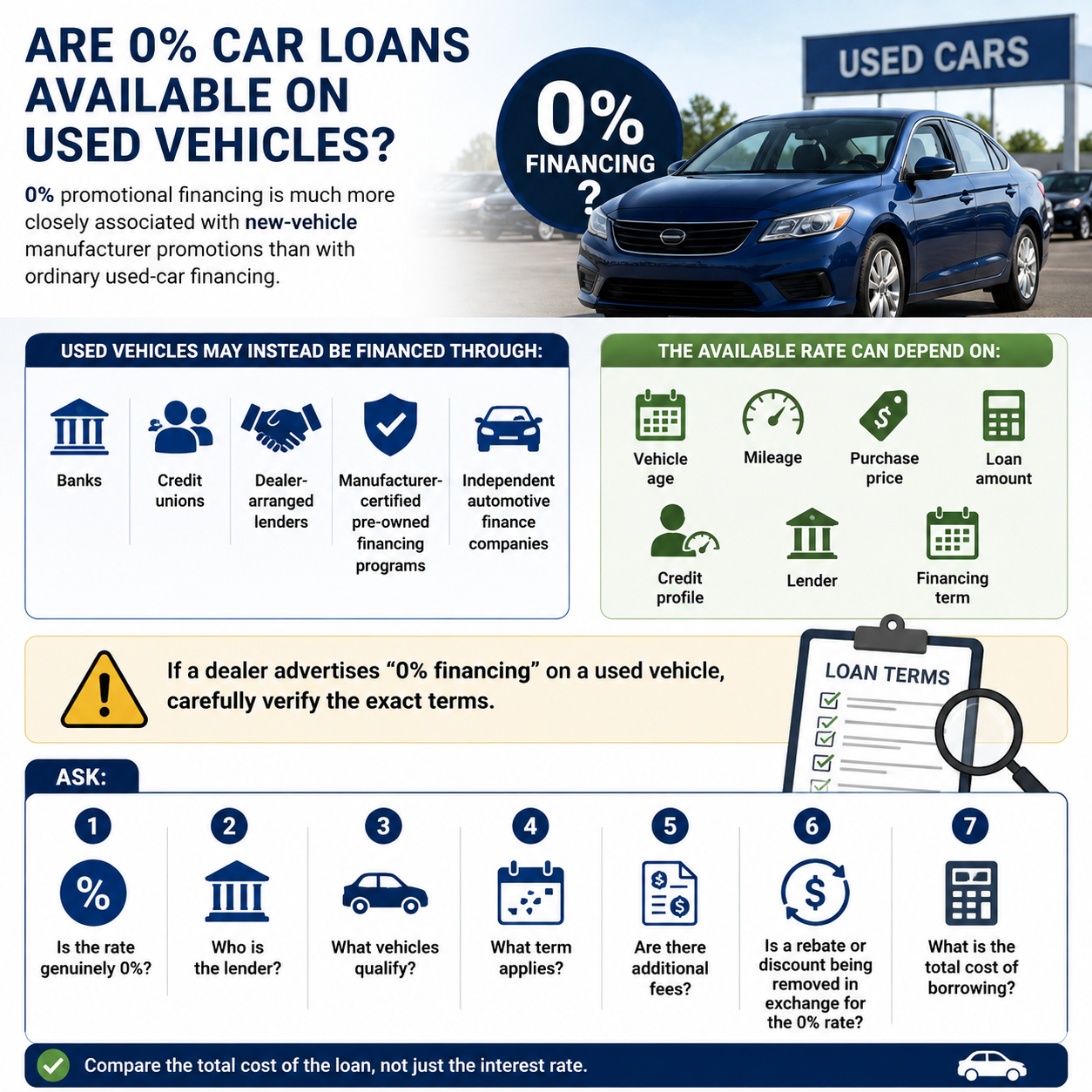
Are 0% Car Loans Available on Used Vehicles?
0% promotional financing is much more closely associated with new-vehicle manufacturer promotions than with ordinary used-car financing.
Used vehicles may instead be financed through:
- banks;
- credit unions;
- dealer-arranged lenders;
- manufacturer-certified pre-owned financing programs;
- independent automotive finance companies.
The available rate can depend on:
- vehicle age;
- mileage;
- purchase price;
- loan amount;
- credit profile;
- lender;
- financing term.
If a dealer advertises "0% financing" on a used vehicle, carefully verify the exact terms.
Ask:
- Is the rate genuinely 0%?
- Who is the lender?
- What vehicles qualify?
- What term applies?
- Are there additional fees?
- Is a rebate or discount being removed in exchange for the 0% rate?
- What is the total cost of borrowing?
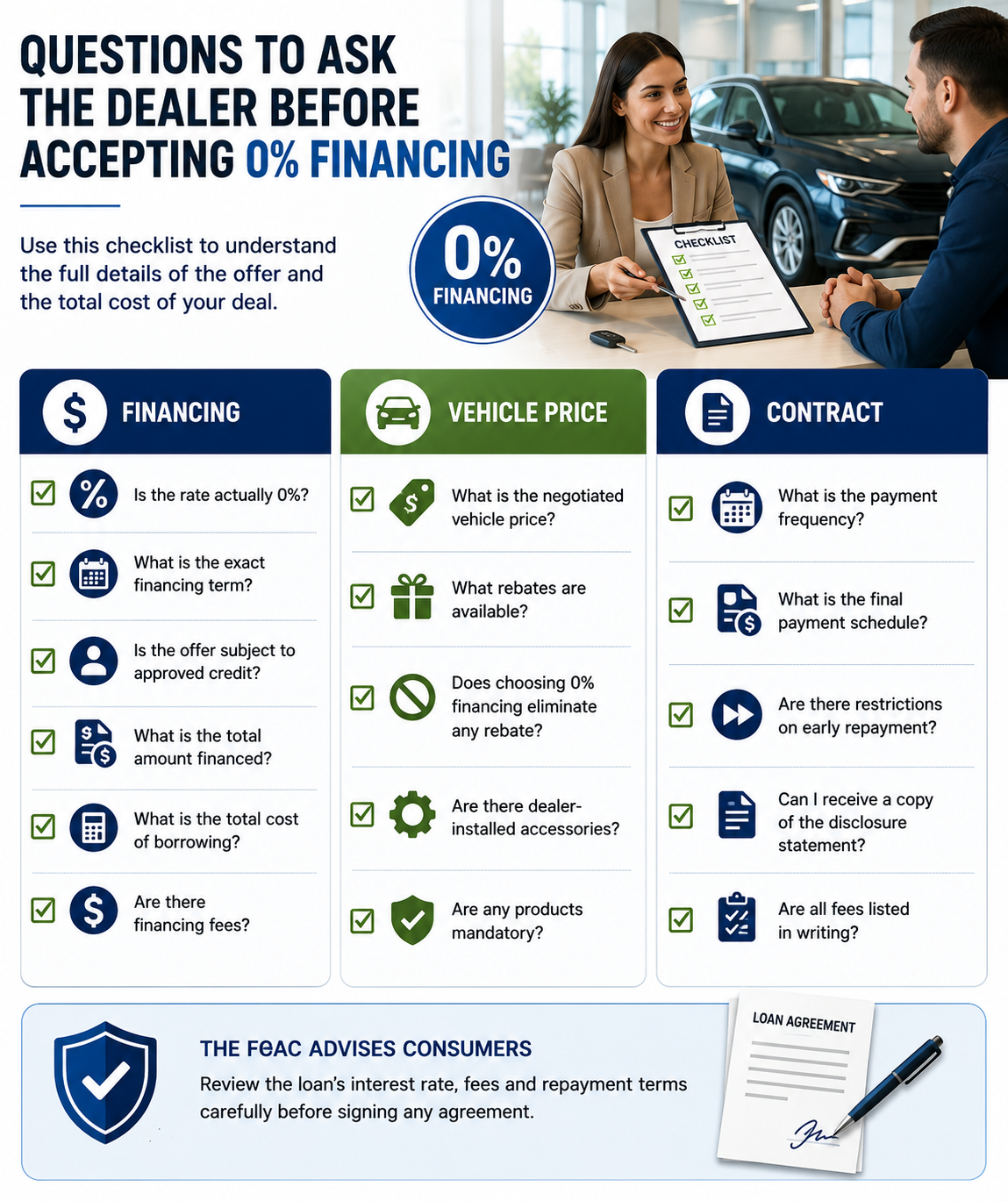
Questions to Ask the Dealer Before Accepting 0% Financing
Use this checklist:
Financing
- Is the rate actually 0%?
- What is the exact financing term?
- Is the offer subject to approved credit?
- What is the total amount financed?
- What is the total cost of borrowing?
- Are there financing fees?
Vehicle price
- What is the negotiated vehicle price?
- What rebates are available?
- Does choosing 0% financing eliminate any rebate?
- Are there dealer-installed accessories?
- Are any products mandatory?
Contract
- What is the payment frequency?
- What is the final payment schedule?
- Are there restrictions on early repayment?
- Can I receive a copy of the disclosure statement?
- Are all fees listed in writing?
The FCAC advises consumers to review the loan's interest rate, fees and repayment terms carefully before signing.
What Fees Should You Check?
A 0% interest rate does not eliminate all costs associated with purchasing a vehicle.
Depending on the transaction and province, review:
- vehicle price;
- freight or destination charges;
- administration or documentation fees;
- registration;
- licensing;
- sales taxes;
- optional warranties;
- protection packages;
- accessories;
- insurance-related products;
- other charges listed in the agreement.
The exact treatment of fees varies by transaction and jurisdiction.
The safest approach is to ask for a complete written breakdown of the transaction before signing.
Do not evaluate an offer solely from:
"$599/month" or: "0% financing."
Ask for the total amount you will pay.
Why Monthly Payment Can Be Misleading
A low monthly payment does not necessarily mean a cheap car loan.
For example, extending a loan over a longer term can reduce the scheduled monthly payment while increasing the period over which the borrower is committed to the vehicle.
With a 0% loan, there is no interest accumulation, but a long term can still create financial risks.
You may:
- owe money on the vehicle for longer;
- build equity more slowly;
- remain exposed to vehicle depreciation;
- have less flexibility if you want to sell or trade the vehicle before the loan is repaid.
The Financial Consumer Agency of Canada specifically advises consumers to understand depreciation, negative equity and the risks associated with long-term car loans.
How to Negotiate a 0% Car Loan
A good negotiation strategy is to separate the vehicle price from the financing decision.
Step 1: Research the vehicle
Know the manufacturer's suggested price and compare similar vehicles.
Step 2: Ask for the vehicle price
Before focusing on the monthly payment, ask for the selling price.
Step 3: Ask for every available incentive
Ask specifically:
- What cash rebates are available?
- What financing promotions are available?
- Can they be combined?
- What do I give up by choosing 0% financing?
Step 4: Request the complete financing quote
Ask for:
- interest rate;
- term;
- payment frequency;
- amount financed;
- total cost of borrowing;
- total scheduled payments;
- fees.
Step 5: Compare outside financing
If your bank or credit union has offered a competitive rate, use it as a benchmark.
Step 6: Review optional products
You do not need to accept every product presented by the finance office.
Ask what each product costs and whether it is optional.
Step 7: Review the final contract
Do not rely solely on a verbal promise.
Make sure the written agreement reflects the terms you accepted.
How to Apply for a 0% Car Loan in Canada
Applying for a 0% car loan is usually part of the vehicle-buying process rather than a separate application for a standalone bank loan. In most cases, the manufacturer or dealership determines whether you qualify for the promotional financing program after reviewing your credit and financial information.
The exact process can vary by manufacturer, lender and dealership, but the typical steps are:
1. Find an Eligible Vehicle
Start by checking which vehicles currently qualify for the 0% financing promotion.
Promotional offers may be limited to:
- specific models or trims;
- selected model years;
- specific financing terms;
- certain provinces or regions;
- participating dealers;
- buyers who meet the lender's credit requirements.
Do not assume that every vehicle at a dealership qualifies for the advertised 0% rate.
2. Check the Financing Terms
Before submitting an application, review the complete promotion.
Pay particular attention to:
- the advertised APR;
- financing term;
- required down payment;
- eligible vehicle models;
- minimum or maximum amount financed;
- offer expiry date;
- approved-credit requirements;
- whether the offer can be combined with rebates or other incentives.
A 0% rate may be available only for a specific term. Choosing a different term could result in a different interest rate.
3. Negotiate the Vehicle Price
Try to negotiate the vehicle price separately from the financing.
Ask the dealer for the selling price before concentrating on the monthly payment. Then ask which incentives are available and whether selecting 0% financing means giving up a cash rebate.
This makes it easier to compare the total cost of the vehicle rather than simply comparing monthly payments.
4. Submit the Financing Application
Once you have selected the vehicle and financing option, you can normally complete a credit application through the dealership or the lender participating in the manufacturer's financing program.
You may be asked to provide information such as:
- full name and contact information;
- residential address;
- employment information;
- income;
- housing information;
- identification;
- Social Insurance Number, where required for the credit application;
- information about existing financial obligations.
The lender may also obtain and review your credit report as part of the application and approval process.
5. Wait for the Credit Decision
The lender reviews the application and determines whether you meet the requirements for the promotional financing rate.
Approval is not guaranteed simply because a vehicle is advertised with 0% financing.
The lender may consider factors such as:
- credit history;
- credit score;
- income;
- existing debt obligations;
- employment and financial stability;
- requested loan amount;
- down payment;
- vehicle eligibility.
You may be approved for financing but not necessarily for the advertised 0% rate if you do not meet the promotion's specific criteria.
6. Review the Approved Offer
If the application is approved, carefully review the financing offer before signing.
Check that the documents show the terms you expected, including:
- 0% interest rate;
- financing amount;
- loan term;
- payment amount and frequency;
- total scheduled payments;
- applicable fees;
- optional products;
- down payment;
- vehicle purchase price.
If the final paperwork differs from the offer discussed with the dealer, ask for an explanation before signing.
7. Sign the Agreement and Complete the Purchase
After you are satisfied with the vehicle price and financing terms, you can complete the purchase and sign the applicable agreements.
Keep copies of the purchase and financing documents for your records.
Your payment schedule will then begin according to the terms of the financing agreement.
What Happens After You Sign?
Once you sign the financing and purchase documents, the agreement becomes important.
In many Canadian jurisdictions, consumers should not assume that they have a general "cooling-off" period for a vehicle purchase or car loan.
The FCAC warns that, in most provinces and territories, there is no general cooling-off period for car loans and leases, although consumers should check the rules applicable to their province or territory.
This makes the pre-signing review particularly important.
Before signing:
- verify the vehicle price;
- verify the financing rate;
- verify the term;
- check all fees;
- remove unwanted optional products;
- confirm the payment;
- confirm the total cost;
- obtain copies of the documents.
0% Financing for EVs and Other Vehicles
Promotional financing can appear across different vehicle categories, including conventional gasoline vehicles, hybrids and electric vehicles, depending on manufacturer strategy and market conditions.
For an EV, do not evaluate the financing promotion separately from the overall purchase economics.
Also consider:
- purchase price;
- available incentives;
- charging costs;
- home-charging equipment;
- insurance;
- expected depreciation;
- warranty;
- battery coverage;
- financing term.
A 0% rate can reduce borrowing costs, but it does not automatically make a more expensive vehicle the better financial choice.
0% Financing by Province
The basic principles of comparing financing apply across Canada, but the final transaction can differ by province or territory because taxes, consumer-protection rules and dealership practices can vary.
Before signing, confirm:
- applicable sales taxes;
- registration and licensing costs;
- dealer fees;
- disclosure requirements;
- cancellation or cooling-off rules, if any;
- provincial consumer-protection requirements.
The FCAC notes that car-loan protections can depend on whether the lender is federally regulated or subject to provincial or territorial rules. It also advises consumers to check the applicable provincial or territorial Consumer Affairs office.
You should not assume that a general online statement about car purchases applies identically in every province.
Final Verdict: Are 0% Car Loans Worth It in Canada?
Yes — but only when the entire deal makes financial sense.
A genuine 0% interest rate can eliminate a major component of borrowing costs and may be particularly attractive when the vehicle price is competitive and the promotion does not require you to sacrifice a larger rebate.
But you should not stop their analysis at the phrase "0% financing."
The better question is:
How much will I pay from the moment I sign the contract until the vehicle is fully paid for?
Compare the vehicle price, incentives, taxes, fees, financing term and total payments.
Get quotes from more than one source, ask the dealer for the complete financing terms, and review the agreement before signing. Canada's financial consumer guidance also recommends comparing financing options and looking at the total cost rather than simply focusing on the monthly payment or advertised interest rate.
For BankChartCanada readers, the most useful rule is simple:
0% is a financing rate — not a guarantee that the entire car deal is the cheapest one available.
Frequently Asked Questions
Are 0% car loans available in Canada?
Yes, manufacturers and their financing divisions may offer promotional 0% financing on selected vehicles and terms. Availability changes frequently, so consumers should verify current Canadian offers directly with the manufacturer or participating dealer.
Is 0% financing really interest-free?
A genuine 0% promotional loan does not charge interest at the advertised rate under the qualifying terms. However, taxes, fees, vehicle costs and optional products may still apply.
What credit score do I need for 0% financing?
There is no universal Canadian credit-score number that guarantees access to every 0% promotional offer. Approval depends on the lender's criteria and the applicant's overall credit and financial profile.
Is 0% financing better than a cash rebate?
Not necessarily. Calculate the total interest you would pay under the rebate option and compare it with the value of the rebate you would give up by choosing 0% financing.
Can I get a 0% used-car loan?
0% promotional financing is generally more associated with new vehicles and manufacturer-backed promotions. Used-car financing options vary by lender, vehicle and borrower.
Can I negotiate a 0% car loan?
You can negotiate aspects of a vehicle purchase and should compare financing offers. A 0% promotional rate may have fixed eligibility or program conditions, but the vehicle price, fees and optional products may still be important areas to discuss.
Does 0% financing mean there are no fees?
No. A 0% rate refers to the financing interest rate. Other costs may still apply.
Should I get pre-approved before going to a dealership?
Obtaining an outside financing quote can give you a useful benchmark for comparing the dealer's financing offer. The best option depends on the rates, incentives and terms available to you.
Can a 0% loan have a long term?
Yes, depending on the promotion. Always compare the financing term and total cost, not only the monthly payment.
What should I compare before signing?
Compare the vehicle price, incentives, financing rate, term, amount financed, fees, payment schedule and total cost.