
What is a corporate credit card?
A corporate credit card in Canada is designed primarily for incorporated businesses with established financial histories and multiple employees. Unlike many small business credit cards, corporate programs may assess the corporation rather than relying primarily on the owner's personal credit and may offer centralized billing, employee spending controls, detailed reporting and higher credit limits. Eligibility, liability and personal guarantee requirements vary by issuer and card program.
What Are Corporate Credit Card Rewards?
Corporate credit card rewards are incentives businesses receive for eligible purchases made with the company's cards. Depending on the program, rewards may include cash back, points, travel benefits, airline rewards, hotel benefits, or other business-related perks.
Common corporate card rewards include:
- Cash back: A percentage of eligible purchases is returned as a statement credit or other form of cash reward.
- Travel points: Companies can earn points that may be redeemed for flights, hotels, rental cars, or other travel expenses.
- Airline rewards: Some programs provide airline-specific points or benefits that can be valuable for companies with frequent business travel.
- Hotel rewards: Corporate travelers may earn hotel points or receive additional travel benefits.
- Business rewards: Certain programs offer enhanced rewards for categories such as office supplies, transportation, technology, advertising, or telecommunications.
- Travel benefits: Depending on the card, benefits may include travel insurance, airport lounge access, rental-car coverage, or other travel-related services.
However, the highest rewards rate does not necessarily make a corporate card the best choice. Businesses should compare rewards against annual fees, foreign transaction charges, redemption restrictions, employee card fees, and other account costs.
For example, a company that spends heavily in US dollars may benefit more from a card or account structure designed for USD spending than from a rewards card with a higher headline points rate but significant foreign exchange costs.
Companies should also consider who controls the rewards. Depending on the program, points or cash-back benefits may belong to the corporation, while travel rewards may be subject to additional terms and restrictions.
The best corporate rewards program is therefore the one that matches the company's actual spending patterns. A business with frequent travel may prioritize travel rewards and insurance, while a company with large recurring operating expenses may prefer straightforward cash back or flexible points.
Corporate Cards vs. Small Business Cards: Key Differences
A common error made by scaling Canadian businesses is continuing to use small business credit cards long after they have outgrown them. Small business cards are generally tied to the business owner’s personal credit bureau. If the business defaults, the owner is personally liable.
Corporate credit cards shift this dynamic. Because they are designed for companies with significant revenues (usually exceeding $2 million to $5 million annually) and multiple employees, the underwriting process evaluates the corporation’s audited financial statements, cash flow, and corporate credit rating. Requirements vary by issuer, card program, company size, financial strength and liability structure. Some programs are aimed at established companies with several years of operating history, while others may be available to businesses with substantially lower revenue. This protects the personal credit of executives and provides substantially higher, shared credit limits.
Small Business Credit Card VS Corporate Credit Card
|
Factor |
Small Business Credit Card |
Corporate Credit Card |
|
Target Market |
Sole proprietors, startups, small teams |
Mid-market, enterprise, large teams |
|
Liability |
Personal guarantee required |
Some corporate card programs are structured without a personal guarantee, but requirements vary by issuer, applicant and liability structure. |
|
Underwriting |
Based on owner's personal credit score |
Based on audited corporate financials |
|
Revenue Requirement |
No strict minimum (often $0+) |
Typically $2M - $5M+ annually |
|
Spend Controls |
Basic (overall limit sharing) |
Advanced (merchant blocking, daily limits, virtual cards) |
|
Key Consideration |
Ideal for maximizing rewards on early-stage spend. |
Essential for scaling operations and protecting personal credit. |
Understanding Corporate Liability Structures in Canada
Corporate and commercial card agreements can use different liability structures. Depending on the issuer and program, liability may rest primarily with the corporation, may involve individual cardholders, or may be subject to separate guarantees or waiver arrangements, for example:
- Corporate Liability: The corporation assumes full legal responsibility for all debts incurred on the cards. Employees face no personal credit checks or financial risk. This is the standard for established Canadian enterprises.
- Joint and Several Liability: Both the corporation and the individual employee are liable for the debt. While the company usually pays the bill centrally, the issuer retains the right to pursue the employee if the company defaults.
- Individual / personal guarantee: The issuer requires an owner, director or other individual to guarantee some or all obligations.
Essential Features for Canadian Businesses
When evaluating corporate credit card programs from the Big 5 banks, American Express, or modern financial platforms, consumers should look beyond reward points and focus on operational efficiency.
CRA Compliance and Expense Management
Managing receipts for the Canada Revenue Agency (CRA) is a persistent administrative burden. Modern corporate cards integrate directly with accounting software like QuickBooks, Xero, or Sage. They allow employees to photograph receipts at the point of sale, automatically matching the image to the transaction and isolating GST/HST for easier Input Tax Credit (ITC) claims.
CAD/USD Cross-Border Spending
Canadian companies frequently pay for software, advertising, and supplies in US dollars. Standard corporate cards often charge a 2.5% foreign transaction fee. Organizations with high cross-border expenses should seek providers that offer dual CAD/USD corporate cards, allowing the company to settle US purchases directly from a US dollar corporate bank account, avoiding costly conversion fees.
Who Should Get a Corporate Credit Card?
Corporate credit cards are generally designed for established Canadian corporations with multiple employees, significant business spending, and a need for centralized expense management. They can be particularly useful when employees regularly purchase travel, supplies, software, advertising, or other business expenses on behalf of the company.
A corporate credit card may be a good fit for a business that:
- Has multiple employees who need authorized spending cards.
- Processes a high volume of business expenses each month.
- Needs individual spending limits and merchant controls.
- Wants centralized billing and consolidated monthly statements.
- Requires detailed expense reporting for accounting and financial management.
- Has significant CAD and USD business expenses.
- Wants to integrate card transactions with accounting or expense-management software.
- Has an established financial history and can meet the issuer's corporate underwriting requirements.
Corporate cards are often less useful for sole proprietors, freelancers, very small businesses, or companies with only one or two employees. These businesses may find that a small business credit card provides sufficient spending capacity, rewards, and expense-management features without the additional requirements of a corporate program.
The right choice ultimately depends on the company's size, spending volume, financial position, number of employees, and preferred liability structure. Businesses should compare the specific requirements and terms of each card program rather than assuming that every corporate card has the same eligibility criteria.
Pros and Cons of Corporate Credit Cards in Canada
|
Pros |
Cons |
|
Centralized employee spending — Employees can use company-issued cards while transactions remain consolidated under the corporate account. |
Stricter eligibility requirements — Some corporate programs are intended for established companies and may require financial information or an established operating history. |
|
Better spending controls — Companies may set employee limits, transaction thresholds, merchant restrictions, and other spending rules. |
Potentially higher fees — Costs may include annual fees, employee card fees, foreign transaction charges, and other program-related fees. |
|
Simplified expense management — Centralized transaction data and reporting can reduce manual reconciliation and improve visibility into company spending. |
Complex liability structures — Liability may rest with the corporation, be shared with individuals, or involve a personal guarantee depending on the program. |
|
Separation of business and personal expenses — Corporate cards help keep employee and company purchases separate from personal spending. |
Personal credit checks may apply — Some business or corporate programs may still require personal credit checks or guarantees, depending on the applicant and liability structure. |
|
Potentially higher spending capacity — Corporate programs may be designed for companies with significant business expenses and larger card programs. |
Rewards may not offset costs — A high rewards rate may be less valuable if annual fees or foreign exchange costs are significant. |
|
Employee cards and virtual cards — Businesses can issue physical or virtual cards for employees, suppliers, departments, or specific expenses. |
More internal controls are required — Companies need clear policies for receipts, approved expenses, spending limits, unauthorized purchases, and employee departures. |
|
Accounting and reporting tools — Many corporate programs provide reporting and integrations that can support accounting and expense management. |
Not ideal for every business — Sole proprietors, startups, and very small companies may find a standard business credit card more appropriate. |
|
Travel and business benefits — Depending on the card, companies may receive travel insurance, purchase protection, rewards, or other business benefits. |
Foreign exchange costs can add up — Companies with substantial USD spending should carefully compare FX fees and currency-conversion costs. |
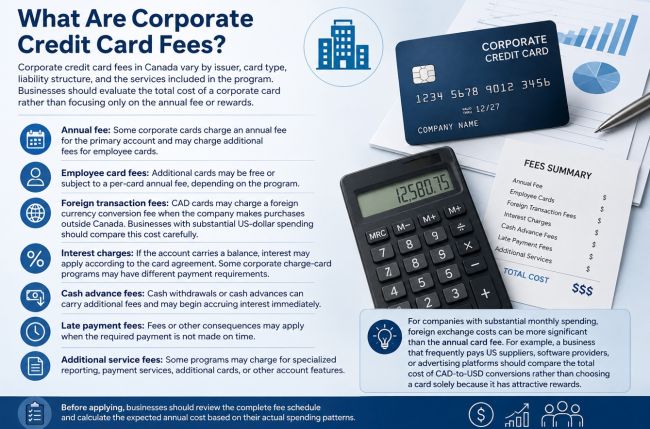
What Are Corporate Credit Card Fees?
Corporate credit card fees in Canada vary by issuer, card type, liability structure, and the services included in the program. Businesses should evaluate the total cost of a corporate card rather than focusing only on the annual fee or rewards.
Common corporate credit card costs may include:
- Annual fee: Some corporate cards charge an annual fee for the primary account and may charge additional fees for employee cards.
- Employee card fees: Additional cards may be free or subject to a per-card annual fee, depending on the program.
- Foreign transaction fees: CAD cards may charge a foreign currency conversion fee when the company makes purchases outside Canada. Businesses with substantial US-dollar spending should compare this cost carefully.
- Interest charges: If the account carries a balance, interest may apply according to the card agreement. Some corporate charge-card programs may have different payment requirements.
- Cash advance fees: Cash withdrawals or cash advances can carry additional fees and may begin accruing interest immediately.
- Late payment fees: Fees or other consequences may apply when the required payment is not made on time.
- Additional service fees: Some programs may charge for specialized reporting, payment services, additional cards, or other account features.
For companies with substantial monthly spending, foreign exchange costs can be more significant than the annual card fee. For example, a business that frequently pays US suppliers, software providers, or advertising platforms should compare the total cost of CAD-to-USD conversions rather than choosing a card solely because it has attractive rewards.
Before applying, businesses should review the complete fee schedule and calculate the expected annual cost based on their actual spending patterns.
How to Apply for a Corporate Credit Card in Canada?
Applying for a corporate credit card in Canada is generally more involved than applying for a personal or small business credit card. Corporate programs are typically designed for established companies and may require detailed information about the corporation's financial position, ownership structure, expected spending, and employees who will receive cards.
The exact application process varies by issuer and card program, but businesses can generally expect the following steps.
- Confirm That Your Business Qualifies
Before applying, review the issuer's eligibility requirements. Corporate card programs may be intended for incorporated Canadian businesses with an established operating history, multiple employees, significant annual revenue, and a satisfactory corporate credit profile.
There is no single revenue threshold that applies to every corporate credit card in Canada. Requirements can vary considerably between issuers and individual programs.
- Choose the Right Corporate Card Program
Compare corporate card programs based on the company's actual needs rather than rewards alone. Important factors include:
- Corporate or joint liability structure
- Personal guarantee requirements
- Annual and employee card fees
- Credit limits
- CAD and USD spending options
- Foreign transaction fees
- Employee spending controls
- Virtual cards
- Expense reporting
- Accounting software integrations
- Rewards and travel benefits
- Corporate credit reporting
A company with substantial US-dollar expenses, for example, may prioritize USD payment capabilities and foreign exchange costs over travel rewards.
- Prepare Your Corporate Information
The issuer will typically need information that identifies the corporation and its owners, directors, or authorized representatives. Depending on the application, this may include:
- Legal corporate name
- Business registration details
- Business number
- Registered business address
- Date of incorporation
- Industry and business activities
- Ownership information
- Director or officer information
- Number of employees
- Expected annual card spending
The exact information requested depends on the issuer and the structure of the card program.
- Prepare Financial Documents
Corporate card applications may require financial information to assess the company's ability to meet its payment obligations. Established companies may be asked to provide financial statements or other supporting documentation.
Potentially requested documents can include:
- Corporate financial statements
- Balance sheet and income statement
- Business bank statements
- Corporate tax information
- Revenue information
- Existing credit information
- Other documents supporting the company's financial position
Not every issuer requires the same documentation, and some applications may be assessed using information already available to the financial institution.
- Determine the Liability Structure
Before signing the application, confirm who is legally responsible for the card balance.
A corporate program may place primary responsibility on the corporation, while another program may involve joint and several liability or a personal guarantee. These distinctions can have important consequences for business owners, directors, and employees.
Do not assume that the term "corporate card" automatically means that no individual can be held responsible for the balance. The cardholder agreement determines the actual liability.
- Add Authorized Employees
Corporate cards are commonly used to distribute spending authority among employees. During the application or account setup process, the company may identify employees who need cards and establish appropriate spending limits.
Businesses should decide in advance:
- Which employees need cards
- Individual credit or spending limits
- Permitted spending categories
- Whether virtual cards are required
- Who can approve transactions
- Whether temporary or single-use cards are needed
Separating employee spending limits from the company's overall credit facility can make expense management and fraud prevention easier.
- Submit the Application
Once the required corporate and financial information has been prepared, the authorized representative can submit the application through the issuer's available application channel.
Depending on the program, the application may be completed online, through a business banking representative, or through a commercial banking relationship.
The issuer may conduct business credit checks and, depending on the program and liability structure, personal credit checks on owners, directors, or authorized individuals.
- Complete the Approval and Account Setup
If the application is approved, the issuer establishes the corporate account and assigns the applicable credit limit and payment terms. The company can then add or activate employee cards and configure available spending controls.
Before employees begin using the cards, the company should establish internal policies covering:
- Permitted business expenses
- Receipt requirements
- Expense submission deadlines
- Personal purchases
- Travel expenses
- Lost or stolen cards
- Unauthorized transactions
- Card cancellation when an employee leaves the company
- Connect the Card to Accounting and Expense Management Systems
The final step is to integrate the corporate card with the company's accounting or expense-management workflow where supported.
Many modern corporate card programs can provide transaction feeds, digital receipt capture, expense categorization, and integrations with accounting platforms. Setting up these systems from the beginning can reduce manual reconciliation and make it easier for the company to maintain appropriate supporting records.
How Long Does It Take to Get a Corporate Credit Card in Canada?
The approval timeline varies by issuer and application complexity. Straightforward applications may move relatively quickly, while larger corporate accounts can take longer because the issuer may need to review financial statements, corporate ownership information, credit history, and the requested liability structure.
Businesses should therefore avoid assuming that a corporate card can be issued immediately. If the company needs cards for an upcoming business trip, procurement project, or employee onboarding, it is advisable to begin the application process well in advance.
What to Check Before Signing the Agreement?
Before accepting a corporate credit card, review the complete cardholder agreement and confirm:
- Who is legally liable for the balance?
- Is a personal guarantee required?
- Are personal credit checks performed?
- What is the approved credit limit?
- What are the annual and employee card fees?
- What foreign transaction fees apply?
- Can the company obtain USD cards?
- How are employee spending limits controlled?
- Does the issuer report activity to business credit bureaus?
- What accounting and expense-management integrations are available?
- What happens if an employee leaves the company?
Best Corporate Credit Cards in Canada
|
Bank & Card Name |
Annual Fee |
Interest Rate |
Key Card Features |
|
American Express Corporate Platinum Card® |
$499 |
Charge Card — no revolving interest rate |
Earn 1.25 points per $1 in corporate spend; premium business travel benefits; dedicated Concierge Service; premium rewards and travel coverage |
|
American Express® Corporate Gold Card |
$75 |
Charge Card — no revolving interest rate |
Earn 1 point per $1 in business spend; expense management and online automation tools; business travel benefits and coverage |
|
American Express® Corporate Card |
$45 |
Charge Card — no revolving interest rate |
Earn 1 point per $1 in business spend; expense management tools; business travel coverage; corporate service and support |
|
American Express® Aeroplan® Corporate Reserve Card |
$699 |
Charge Card — no revolving interest rate |
Premium Aeroplan business travel benefits; Annual Worldwide Companion Pass; travel rewards, benefits and coverage |
|
American Express® Aeroplan® Corporate Card |
$120 |
Charge Card — no revolving interest rate |
Aeroplan points on business purchases; premium business travel benefits; travel coverage and corporate expense management |
|
BMO Corporate MasterCard |
Contact issuer |
Contact issuer |
Consolidated billing, online reporting, expense management and spending controls |
USD Corporate Credit Cards in Canada
USD corporate credit cards can be useful for Canadian companies that regularly purchase goods and services from US-based suppliers. Common examples include software subscriptions, online advertising, travel, cloud services, professional services, and cross-border inventory purchases.
A traditional CAD credit card generally converts a US-dollar transaction into Canadian dollars when the purchase is processed. The issuer may then apply a foreign currency conversion fee in addition to the exchange rate used for the transaction.
A USD corporate credit card takes a different approach. Eligible purchases are charged in US dollars and the statement is generally settled in USD. This can reduce the need to convert US-dollar transactions into Canadian dollars for every purchase.
Who Should Consider a USD Corporate Card?
A USD corporate card may be particularly useful for companies that:
- Make frequent purchases from US suppliers.
- Pay recurring software or cloud-service subscriptions in USD.
- Spend significant amounts on US-based advertising platforms.
- Have employees who regularly travel to the United States.
- Maintain a US-dollar corporate bank account.
- Want more predictable management of USD expenses.
However, a USD card does not automatically eliminate every foreign exchange cost. Businesses should compare the card's annual fee, exchange rates, account requirements, payment arrangements, and any applicable transaction fees.
Before choosing a USD corporate card, companies should also confirm whether the card can be linked to or paid from an appropriate US-dollar business account and whether employee cards are available under the same program.
Virtual Corporate Credit Cards
Virtual corporate credit cards are digital card numbers that can be issued to employees, departments, projects, or specific business purposes without providing a traditional physical card.
They can be particularly useful for online purchases and recurring business expenses. For example, a company could create a virtual card for software subscriptions, digital advertising, travel bookings, or a specific supplier.
Depending on the provider, businesses may be able to configure:
- Spending limits
- Transaction limits
- Expiration dates
- Merchant restrictions
- Employee-specific cards
- Department or project budgets
- Temporary or single-use cards
Virtual cards can improve security because the company does not need to expose its primary corporate card number for every online transaction. A virtual card can also be cancelled or replaced without necessarily affecting other employee cards.
Common Uses for Virtual Corporate Cards
Companies may use virtual cards for:
Software subscriptions: A separate card can be assigned to recurring SaaS payments and monitored against a specific budget.
Online advertising: Marketing teams can receive controlled payment credentials for platforms such as advertising networks.
Travel: Employees can use virtual cards for approved hotels, flights, or other travel expenses.
Procurement: A virtual card can be assigned to a specific supplier or purchasing project.
Temporary expenses: A company can issue a card with a predefined limit and expiration date for a particular transaction.
Virtual cards are not necessarily a replacement for physical corporate cards. Many businesses use both, giving employees physical cards for travel and in-person purchases while using virtual cards for online and recurring expenses.
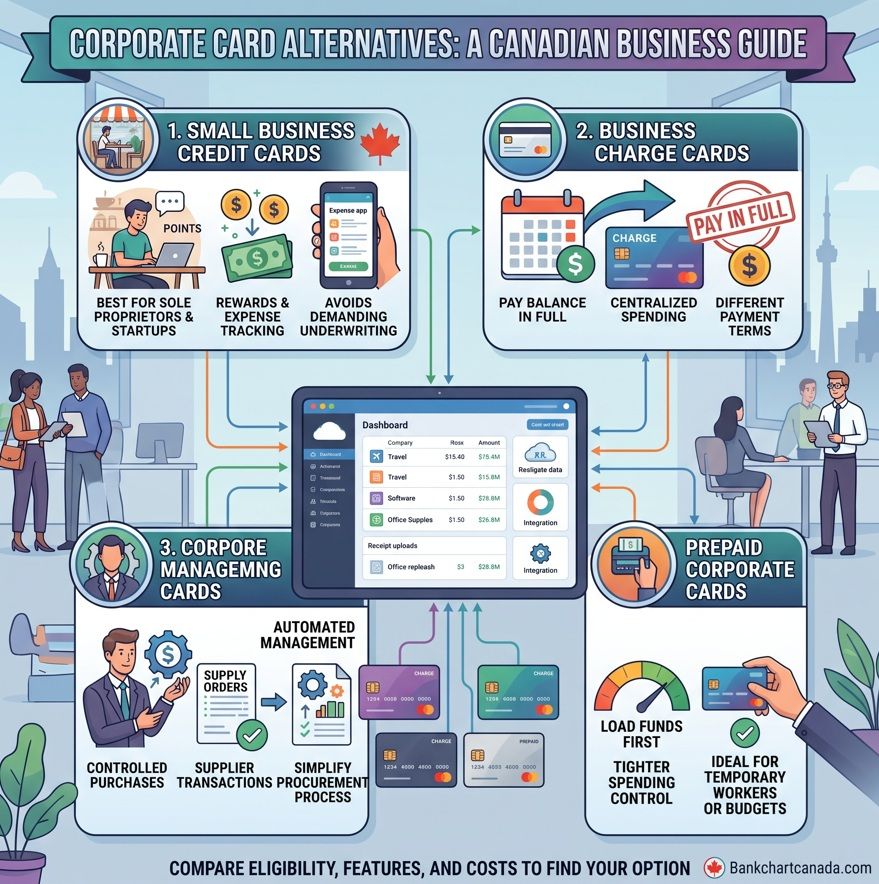
Corporate Card Alternatives
A traditional corporate credit card is not the only way for a Canadian company to manage employee spending. Depending on the company's size, financial position, and spending requirements, several alternatives may be more appropriate.
Small Business Credit Cards
Small business credit cards are often better suited to sole proprietors, startups, and smaller incorporated businesses.
They can provide rewards, employee cards, expense tracking, and business-specific benefits without the potentially more demanding underwriting associated with some corporate programs.
However, personal guarantees or personal credit checks may apply, depending on the issuer and card agreement.
Business Charge Cards
Business charge cards can provide centralized employee spending and may be useful for companies that prefer to pay their balance in full rather than carry a revolving balance.
The payment requirements and underwriting criteria vary by provider, so businesses should review the specific terms before applying.
Corporate Purchasing Cards
Purchasing cards, sometimes called procurement or purchasing cards, are designed primarily for controlled business purchases. They can be useful for organizations with centralized procurement processes and a large number of recurring supplier transactions.
Companies may use purchasing cards to establish spending policies, simplify procurement, and consolidate transactions for accounting purposes.
Expense Management Platforms
Modern expense-management platforms can combine corporate or commercial cards with software for employee spending, receipt collection, approvals, reporting, and accounting integrations.
These solutions can be attractive to companies that prioritize automated expense management and spending controls rather than traditional credit-card rewards.
Some platforms may use a credit facility, while others may provide cards backed by the company's existing cash balance. Businesses should therefore distinguish between a true credit product and a spend-management card linked to corporate funds.
Prepaid Corporate Cards
Prepaid corporate cards allow companies to load funds onto cards before employees use them. They can provide tighter control over spending because employees generally cannot spend beyond the available balance.
They may be suitable for temporary workers, controlled budgets, travel expenses, or companies that do not want to extend a traditional revolving credit facility.
However, prepaid cards may offer fewer features than a full corporate credit card, particularly when it comes to credit-building, financing, rewards, or higher spending limits.
Do Corporate Credit Cards Build Business Credit in Canada?
A corporate credit card may contribute to a company's business credit history, but businesses should not assume that every corporate card automatically builds corporate credit.
Whether card activity is reported to Canadian business credit bureaus depends on the issuer, the specific card program, the account structure, and the bureau to which information is reported. Some corporate card programs may report account activity, while others may not provide the same type of business credit reporting.
A company's business credit profile is separate from an owner's personal credit profile. A strong business credit history can help demonstrate the corporation's financial reliability when applying for certain forms of commercial financing, credit facilities, supplier accounts, or other business services.
Before applying for a corporate credit card, ask the issuer:
- Does the card issuer report account activity to Canadian business credit bureaus?
- Which business credit bureaus receive the information?
- Are payment histories reported?
- Does the corporate card application involve a personal credit check?
- Will the account appear on an owner's personal credit report?
- Does the liability structure affect how the account is reported?
Businesses should also distinguish between building business credit and avoiding personal credit impact. A corporate card may be structured primarily around the corporation's financial position, but the exact treatment depends on the issuer and agreement.
For this reason, companies should confirm the issuer's credit-reporting and liability policies before opening an account rather than assuming that a corporate card will automatically improve the company's business credit score or have no effect on personal credit.
Frequently Asked Questions (FAQ)
Do I need to provide a personal guarantee for a Canadian corporate credit card?
Generally, no. True corporate credit cards in Canada operate under a Corporate Liability structure. Underwriting is based strictly on the corporation's financial standing, credit history, and audited financial statements. Because liability rests solely with the corporation, business owners and executives are typically not required to sign a personal guarantee, and account activity does not affect personal credit scores.
However, if a business does not meet corporate underwriting thresholds, financial institutions may offer Joint and Several Liability programs or recommend a small business credit card, both of which require a personal guarantee.
What is the minimum revenue required for a corporate credit card in Canada?
Traditional Canadian commercial lenders (including RBC, TD, Scotiabank, BMO, CIBC, and American Express) typically require $2 million to $5 million in annual gross revenue to qualify for a traditional corporate credit card program. Issuers generally also mandate:
- 2 to 3 years of audited corporate financial statements.
- A minimum number of active cardholders (usually 10 to 15 employees).
- A established corporate credit history in Canada.
Businesses generating under $2 million in revenue that still require corporate card features (such as high limits and automated receipt matching) often utilize Canadian spend-management platforms. These platforms issue corporate cards backed by existing corporate cash balances rather than traditional unsecured lines of credit.
How do corporate credit cards handle CRA receipt compliance?
Modern corporate credit card programs streamline Canada Revenue Agency (CRA) compliance by replacing paper processing with automated digital record-keeping.
When a transaction occurs, the employee captures a photo of the receipt via a mobile application. The platform's software automatically:
- Extracts transaction metadata (vendor, date, total amount).
- Matches the receipt image directly to the posted credit card transaction feed.
- Isolates and categorizes GST/HST/PST amounts paid.
- Syncs the reconciled entry directly into accounting platforms such as QuickBooks Online, Xero, or Sage.
The CRA accepts digital images of supporting documents provided they are legible, accurate, and permanently stored. This integration ensures the business can substantiate Input Tax Credit (ITC) claims during a tax audit.
Can I get a corporate credit card that bills directly in US Dollars?
Yes. Most major Canadian commercial banks and credit card issuers offer dedicated USD corporate credit cards.
These cards allow Canadian businesses with significant cross-border spending—such as software subscriptions, digital advertising, or US supplier purchases—to settle charges directly in US Dollars.
- Key Benefit: Eliminates standard foreign transaction conversion fees (which typically average 2.5% per transaction on Canadian-dollar cards).
- Requirement: To avoid conversion fees entirely, the corporation must settle the monthly card statement using a US Dollar commercial bank account maintained at a Canadian financial institution.
Does a corporate credit card affect personal credit?
It depends on the card program and liability structure. A corporate credit card may be underwritten primarily based on the corporation's financial position and may not be reported to the owner's personal credit bureau. However, some programs may involve personal credit checks or guarantees.
Before applying, confirm with the issuer whether the application requires a personal credit check, whether the account is reported to personal credit bureaus, and whether any personal guarantee applies. The cardholder agreement ultimately determines the company's and individuals' obligations.
Can employees have individual corporate cards?
Yes. Corporate credit card programs are specifically designed to allow businesses to issue cards to multiple employees or authorized users.
Depending on the issuer, the company may be able to assign individual spending limits, merchant restrictions, transaction controls, and reporting permissions to each cardholder. Employee transactions are typically consolidated into the company's central account, making it easier for finance teams to monitor spending and reconcile expenses.
Businesses should establish clear policies for receipts, approved expenses, spending limits, and card cancellation when an employee leaves the company.
Can corporate cards be used for travel?
Yes. Corporate credit cards are commonly used for business travel, including flights, hotels, car rentals, restaurants, and other eligible travel expenses.
Depending on the card program, companies may also receive travel-related benefits such as travel insurance, airport lounge access, rental-car coverage, or travel rewards. Businesses should compare these benefits with annual fees, foreign transaction charges, and other costs.
For companies with frequent international travel, a corporate card with favourable foreign exchange terms or a USD card may be particularly useful.