Instant payday loans for students provide fast access to short-term cash—typically up to $1,500—but they are the most expensive form of borrowing in Canada. While the rapid approval process makes them appealing during a cash crunch, the extremely high borrowing costs can quickly consume a part-time student income.
How Payday Loans Work for Canadian Students
To qualify for a payday loan, lenders generally require an active Canadian bank account, government-issued ID, and proof of recurring income. For students, income verification can be a hurdle. While some lenders accept part-time employment income or regular bank deposits, many do not accept provincial or federal student aid (such as OSAP, Alberta Student Aid, or StudentAid BC) as qualifying income.
The loan must typically be repaid in full by your next payday or within 14 to 28 days. If you fail to repay the loan on time, you will face non-sufficient funds (NSF) fees from both your bank and the lender, alongside additional penalty interest.
Eligibility requirements
|
Requirement |
Usually Required? |
What It Means for Students |
|
Canadian bank account |
Yes |
Required by most lenders |
|
Government-issued ID |
Yes |
Standard identity verification |
|
Employment income |
Usually |
Part-time income may qualify |
|
Credit score |
Often not required |
Poor or limited credit may be accepted |
|
Student aid |
Depends on lender |
May not qualify as recurring employment income |
|
Canadian residency |
Yes |
Requirements vary |
How Much Can a Student Borrow?
The amount a student can borrow through a payday loan depends on the lender, provincial regulations and the applicant's financial situation. Payday loans are designed for short-term borrowing, so the available amount may be significantly lower than what a student could obtain through a line of credit or other forms of financing.
Lenders may consider factors such as:
- regular employment or other accepted income;
- the frequency and amount of income deposits;
- the applicant's banking history;
- existing financial obligations;
- provincial borrowing limits.
Having a higher income does not necessarily mean that borrowing the maximum available amount is a good idea. Students should borrow only what they can realistically repay in full by the required repayment date.
For example, borrowing $500 can result in a significant borrowing fee, depending on the province. Before accepting a loan, calculate the total repayment amount—not just the amount you receive—and make sure it fits within your next expected income payment.
Licensed Payday Lenders in Canada: Comparison for Students
|
Lender |
Max Amount |
Fee Structure |
Funding Speed |
Student Income & Eligibility Considerations |
|
iCash |
Up to $1,500 |
$14 – $17 per $100 (provinces set max rate) |
Instant 24/7 via Interac e-Transfer |
Accepts part-time employment & select benefits; minimum $800/mo income required. |
|
Money Mart |
Up to $1,500 |
$14 – $17 per $100 (provinces set max rate) |
Same-day in-store cash or online e-Transfer |
Online or physical branches near major campuses; accepts multiple income sources. |
|
Cash Money |
Up to $1,500 |
$14 – $17 per $100 (provinces set max rate) |
Express funding within 15 minutes |
Flexible income evaluation; considers part-time wages and secondary income streams. |
|
GoDay |
Up to $1,500 |
$14 – $17 per $100 (provinces set max rate) |
Automated 24/7 e-Transfer |
100% online process; requires proof of direct deposit from a Canadian bank account. |
|
Loan Express |
Up to $1,500 |
$14 – $17 per $100 (provinces set max rate) |
Instant e-Transfer in under 5 minutes |
No credit check required; focuses strictly on active bank account history and steady income. |
|
My Canada Payday |
Up to $1,500 |
$14 – $17 per $100 (provinces set max rate) |
24/7 approval & instant funding |
Canadian-owned; accommodates lower initial limit options for borrowers with limited history. |
What Should You Do Before Taking a Payday Loan?
Before taking out a payday loan, students should take a few minutes to compare the total cost with other available options. Payday loans can provide fast access to cash, but their short repayment periods and high fees can make them difficult to manage on a limited student budget.
Consider taking these steps first:
- Calculate the full repayment amount. Check exactly how much you will need to repay, including all permitted fees.
- Check your next expected income. Make sure you will have enough money to repay the loan without missing rent, food, transportation or other essential expenses.
- Compare cheaper alternatives. Look at student overdrafts, student lines of credit, emergency bursaries and payment arrangements before using high-cost credit.
- Verify that the lender is licensed. Payday lenders must follow the rules that apply in the province where they operate.
- Read the loan agreement carefully. Pay attention to the repayment date, borrowing fees, cancellation rights and the consequences of a missed payment.
- Avoid borrowing to repay another loan. Taking new high-cost credit to cover an existing debt can create a difficult cycle of borrowing.
A payday loan should generally be considered a last-resort option for a short-term emergency, rather than a solution for ongoing financial problems.
How Fast Can a Student Get a Payday Loan?
The time it takes to receive a payday loan depends on the lender, the application process and the method used to send the funds. Some lenders can review an application and provide a decision within minutes, while funding may be available on the same day once the application is approved and the required verification is complete.
However, students should be cautious with the word “instant.” An instant approval does not always mean that the money will appear in your bank account immediately. Identity verification, income verification, bank processing times and the time of day can all affect how quickly funds are received.
Before applying, check:
- how long the lender typically takes to review an application;
- whether same-day funding is available;
- the method used to deposit the money;
- whether applications submitted outside business hours are processed immediately or on the next business day.
If the expense is urgent, students should also compare faster and potentially cheaper options, such as an existing overdraft facility, a credit card, or emergency financial assistance from their college or university.
Provincial Fee Limits: What You Will Actually Pay
In Canada, payday loans are regulated at the provincial level. Instead of a traditional annual percentage rate (APR), lenders charge a flat fee per $100 borrowed.
Depending on your province of residence, the maximum legally permitted fee ranges from $14 to $17 per $100 borrowed. In Quebec, payday loans are effectively illegal because the province enforces a strict 35% annual interest rate cap, which standard payday lenders cannot meet.
The Debt Trap: A Practical Student Example
The advertised "fee per $100" often disguises the true cost of borrowing. When annualized, the APR on a payday loan is typically between 390% and 442%.
Illustrative Example: Borrowing $300 for 14 days in Ontario
- Amount Financed: $300
- Provincial Maximum Fee: $15 per $100
- Total Fee: $45
- Total Repayment Due in 14 Days: $345
If a student earns a minimum wage of $16.55 per hour, they must work nearly three additional hours (before taxes) strictly to pay the borrowing fee on a $300 loan. If the student cannot repay the $345 in full, they may be forced to borrow again, triggering a well-documented cycle of debt.
Table 1: Maximum Payday Loan Fees by Province (per $100 borrowed)
|
Province |
Maximum Fee per $100 |
Equivalent APR (14-day term) |
|
Manitoba |
$14.00 |
365% |
|
Newfoundland & Labrador |
$14.00 |
365% |
|
Ontario, BC, Alberta, NB, NS, PEI |
$15.00 |
391% |
|
Saskatchewan |
$17.00 |
443% |
|
Quebec |
N/A (Subject to 35% annual cap) |
N/A |
Table 2: Payday Loan vs. Student Line of Credit ($500 Loan for 30 Days)
|
Factor |
Payday Loan (Ontario) |
Student Line of Credit |
|
Approval Speed |
Same day (Instant) |
1 to 5 business days |
|
Eligibility |
Proof of income required |
Credit check / Co-signer often required |
|
Estimated Interest/Fees |
$75.00 |
~$3.50 (Assuming 8.2% annual interest) |
|
Repayment Terms |
Full balance due on next payday |
Interes |
Better Financial Alternatives for Students
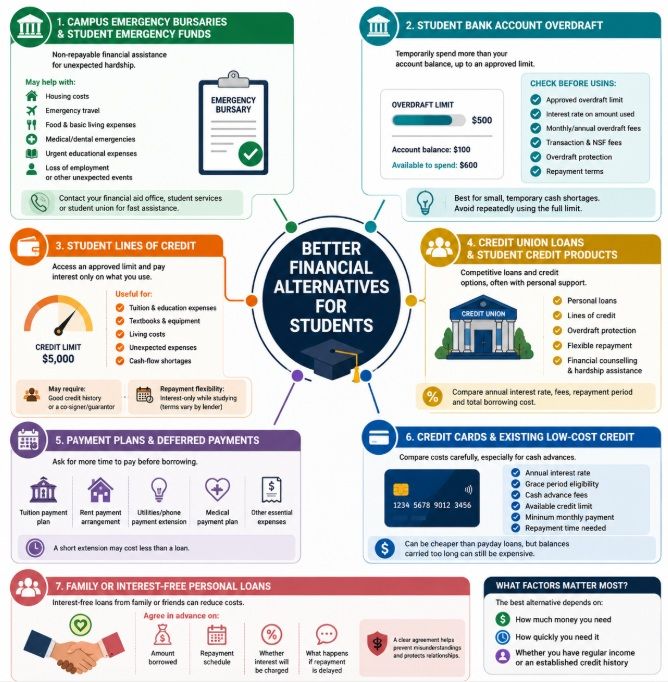
Before accepting the high cost and short repayment period of a payday loan, students should explore other ways to cover an unexpected expense. Depending on the situation, options such as emergency bursaries, student overdrafts and student lines of credit may provide access to funds at a significantly lower cost.
The best alternative depends on how much money you need, how quickly you need it and whether you have regular income or an established credit history.
Campus Emergency Bursaries and Student Emergency Funds
Many Canadian colleges and universities provide emergency financial assistance for students experiencing unexpected financial hardship. Depending on the institution and the circumstances, support may be available as a non-repayable bursary, grant, emergency fund or short-term financial assistance.
Emergency funding may help students deal with expenses such as:
- unexpected housing costs;
- emergency travel;
- food and basic living expenses;
- medical or dental emergencies not fully covered by insurance;
- urgent educational expenses;
- temporary financial hardship caused by a loss of employment or other unexpected events.
Unlike a payday loan, a non-repayable bursary does not need to be paid back. Eligibility requirements and the amount of available assistance vary by institution, and some programs may require students to demonstrate financial need or provide supporting documentation.
If you need money quickly, contact your school's financial aid office, student services department or student union. Some institutions may have emergency assistance programs that can be accessed faster than applying for traditional credit.
Student Bank Account Overdraft
An overdraft facility can be a useful option for students who already have an eligible Canadian bank account. Instead of applying for a separate high-cost loan, an overdraft allows you to temporarily spend more money than is currently available in your chequing account, up to an approved limit.
For example, if you have a $500 overdraft limit and your account balance is $100, you may be able to make eligible payments that temporarily take your account balance below zero, subject to the bank's terms and approval.
The main advantage over a payday loan is that borrowing costs may be substantially lower. Depending on the account and bank, you may pay interest on the amount used and, in some cases, an overdraft protection fee.
Before relying on an overdraft, check:
- your approved overdraft limit;
- the interest rate charged on the amount used;
- monthly or annual overdraft fees;
- transaction and NSF fees;
- whether overdraft protection applies automatically or must be activated;
- how and when the negative balance must be repaid.
An overdraft is generally more suitable for a small, temporary cash shortage than for long-term financial problems. Students should avoid repeatedly using the full overdraft limit if they do not have a clear plan for bringing the account balance back above zero.
Student Lines of Credit
A student line of credit can be one of the most affordable borrowing options for larger or ongoing education-related expenses. Unlike a payday loan, which normally requires repayment within a short period, a line of credit provides access to an approved borrowing limit that you can use when needed.
You generally pay interest only on the amount you actually borrow rather than on the entire approved credit limit. Depending on the financial institution and the student's circumstances, the interest rate may be linked to the bank's prime rate plus an additional percentage.
A student line of credit may be useful for:
- tuition and education expenses;
- textbooks and equipment;
- living costs during the academic year;
- unexpected but significant expenses;
- temporary cash-flow shortages.
However, approval requirements can be stricter than for a payday loan. A bank may review your credit history, income, program of study and overall financial situation. Students with limited credit history may need a co-signer or guarantor, depending on the lender and product.
One advantage is greater repayment flexibility. Some student credit products allow borrowers to make interest-only payments while studying, with full principal repayment beginning later under the product's repayment terms. Students should carefully review the agreement because repayment conditions can vary significantly between lenders.
Credit Union Loans and Student Credit Products
Credit unions may also offer personal loans, lines of credit or student-focused borrowing options. These products can be worth comparing with offers from major banks, particularly if you already have an account or membership with a local credit union.
Depending on the institution, a credit union may offer:
- smaller personal loans;
- lines of credit;
- overdraft protection;
- flexible repayment schedules;
- financial counselling or hardship assistance.
Approval is not guaranteed, and borrowing costs still apply, but the total cost may be considerably lower than that of a payday loan. Compare the annual interest rate, fees, repayment period and total borrowing cost before accepting an offer.
Payment Plans and Deferred Payments
Before borrowing money, students should consider whether the company or organization requesting payment can offer additional time.
For example, you may be able to arrange:
- a tuition payment plan with your college or university;
- a rent payment arrangement with your landlord;
- an extended payment deadline for a utility or phone bill;
- a medical payment plan;
- a payment arrangement for other essential expenses.
This option can be particularly valuable when the financial problem is temporary. If you only need an additional week or two to receive your next income payment, negotiating a payment extension may cost less than borrowing money through a payday lender.
Credit Cards and Existing Low-Cost Credit
Students who already have a credit card or other approved credit facility may have access to a lower-cost alternative to a payday loan. However, students should compare the cost carefully, especially when considering a cash advance.
A credit card purchase may provide a grace period if the balance is paid according to the card's terms. A cash advance, on the other hand, may begin accruing interest immediately and can include additional fees.
Before using a credit card to cover an emergency, check:
- the annual interest rate;
- whether the transaction qualifies for a grace period;
- cash advance fees;
- your available credit limit;
- the minimum monthly payment;
- how long it would realistically take to repay the balance.
Credit cards can be cheaper than payday loans in some situations, but carrying a balance for an extended period can still become expensive.
Family or Interest-Free Personal Loans
If available, borrowing from family or trusted friends may be another alternative to high-cost credit. An interest-free loan can significantly reduce borrowing costs compared with a payday loan.
However, students should treat this arrangement seriously. It is helpful to agree in advance on:
- the amount being borrowed;
- the repayment schedule;
- whether any interest will be charged;
- what happens if repayment is delayed.
A clear agreement can help prevent misunderstandings and protect personal relationships.
Which Alternative Is Best for Students?
There is no single option that works for every situation. However, students can generally start by exploring non-repayable emergency assistance before taking on new debt.
A practical order of consideration may be:
- Campus emergency bursaries or grants — potentially the lowest-cost option because the money may not need to be repaid.
- Payment extensions or payment plans — useful when the expense can be postponed without taking on new debt.
- Existing student overdraft protection — potentially suitable for a small, short-term cash shortage.
- Student line of credit or other lower-cost credit — potentially more suitable for larger expenses or longer repayment periods.
- Credit union loans or personal loans — worth comparing if other student-focused options are unavailable.
- Family or interest-free borrowing — potentially inexpensive when available and when repayment expectations are clear.
- Payday loans — generally best viewed as a last-resort option because of their high fees and short repayment period.
Before choosing any borrowing option, students should compare the total cost of borrowing, repayment deadline and potential consequences of missing a payment. The fastest option is not always the cheapest, and borrowing money to solve a short-term cash shortage can create a larger financial problem if the full balance cannot realistically be repaid on time.
Are Payday Loans Safe for Students?
A payday loan from a properly licensed lender can be a legal form of borrowing in Canada, but that does not necessarily mean it is a safe or affordable financial choice for every student. The main risk is usually not the application process itself—it is the high cost and short repayment period.
Payday loans can become particularly risky when a student already knows that they will not have enough money to repay the full balance by the due date. In that situation, borrowing may simply move the financial problem to the next payday.
Students should also watch for potential loan scams. Warning signs can include:
- requests for an upfront payment before receiving the loan;
- promises of guaranteed approval regardless of circumstances;
- requests for passwords or sensitive online banking credentials;
- unclear information about the total borrowing cost;
- pressure to sign immediately;
- a lender that cannot clearly demonstrate that it is authorized to operate in the relevant province.
Before borrowing, verify the lender, read the agreement and compare the loan with lower-cost alternatives. For most students, options such as an emergency bursary, student overdraft or line of credit may be a more sustainable way to deal with a temporary cash shortage.
Pro-Tip from the Editor Olesya Krasavtseva, Content Editor at Prostobank Consulting
"The most expensive financial mistake students make is borrowing reactively. Before you ever face a cash crunch, ask your current bank to add a small student overdraft protection limit (typically $250 to $500) to your chequing account. While a payday loan will cost you up to $15 for every $100 borrowed for just 14 days, a student overdraft usually costs a minimal flat monthly fee, plus just a few cents in daily interest. Proactive banking is always your cheapest defense against emergency debt."
Frequently asked questions
Can I get a payday loan in Canada using OSAP or student loans as income?
Generally, no. Eligibility varies by lender and province. Student loans and grants may not qualify as employment income, and applicants should confirm directly with the lender which types of recurring deposits are accepted.
Payday loan regulations require lenders to verify a steady, recurring source of income, which typically means employment wages or certain government benefits (like CPP, EI, or disability support). Because student loans are temporary financial assistance intended for education and must eventually be repaid, lenders do not classify them as earned income or regular earnings.
Do payday loans affect a Canadian student's credit score?
Taking out and repaying a payday loan on time usually does not help build your credit score. Most payday lenders in Canada do not report regular, on-time payments to the two main credit bureaus (Equifax Canada and TransUnion Canada).
However, defaulting on a payday loan will severely harm your credit score:
- Collection Accounts: If you miss payments, the lender will hand the debt over to a collection agency, which reports the default to credit bureaus.
- Long-Term Impact: A collection entry remains on your credit report for up to 6 years, making it difficult to qualify for credit cards, auto loans, apartment rentals, or student lines of credit in the future.
What happens if a student cannot repay a payday loan in Canada?
If you miss your repayment deadline, several financial and legal consequences occur:
- Double NSF Fees: The lender will attempt to withdraw the funds automatically from your account. If you lack sufficient funds, your bank will charge a Non-Sufficient Funds (NSF) fee (typically up to $48), and the payday lender will charge a provincial NSF penalty (usually $20–$25).
- Penalty Interest: Lenders can legally charge additional late interest on the outstanding principal (capped provincially, often around 2.5% per month or 30% per year).
- No Rollover Loans: Under provincial laws (e.g., in Ontario, BC, and Alberta), lenders are legally prohibited from "rolling over" your unpaid balance into a new payday loan with fresh borrowing fees.
- Collections and Legal Action: Persistent non-payment leads to collection agency harassment and potential legal action, which can result in court-ordered wage garnishments from part-time employment.
Are there payday loans for international students in Canada?
While international students are not legally prohibited from applying, qualifying is extremely difficult. To get approved, an international student must typically provide:
- Proof of a valid study permit and legal residency status in Canada.
- An active Canadian bank account with 30 to 90 days of transaction history.
- Proof of regular employment income earned in Canada (subject to study permit work hour limits).
Foreign bank accounts, money transfers from parents abroad, and international scholarships do not qualify as eligible Canadian income. Given the high risk of debt and potential impact on study permit compliance, international students facing financial emergencies should seek campus bursaries or international student support funds instead.
Can a full-time student get a payday loan in Canada?
Yes, a full-time student may be able to qualify for a payday loan in Canada, but being a student does not automatically make you eligible. Payday lenders generally assess whether you meet their income, identification and banking requirements. A student with regular employment income from a full-time or part-time job may have a better chance of qualifying than a student who has no recurring income.
Requirements vary by lender and province. Before applying, check exactly which types of income the lender accepts and whether the lender is properly licensed in your province.
Can I get a loan as a student with no income?
It can be difficult to qualify for a traditional payday loan if you have no regular source of income. Payday lenders generally require borrowers to demonstrate that they have income or recurring funds available to repay the loan.
If you are a student without employment income, consider alternatives before applying for high-cost credit. Depending on your situation, these may include:
- university or college emergency bursaries;
- student financial assistance;
- a student line of credit with a co-signer;
- an overdraft facility;
- emergency assistance from your student union;
- a payment arrangement with your landlord, school or service provider.
Approval requirements vary, so do not assume that being a student automatically qualifies you for a payday loan.
Can I use a scholarship as income for a payday loan?
It depends on the lender. A scholarship may provide financial support while you study, but a payday lender may not necessarily treat it as qualifying income for a loan application.
Lenders can have different requirements regarding acceptable income sources. Some may require regular employment income or other recurring deposits that meet their underwriting criteria. A one-time scholarship payment may be treated differently from recurring income.
Before applying, ask the lender directly whether scholarships, bursaries or other education-related funding are accepted as qualifying income. You should also avoid describing a scholarship as employment income if it is not.
Can I cancel a payday loan after signing the agreement?
Yes, you may have a legal right to cancel a payday loan shortly after signing the agreement, but the cancellation period depends on your province.
For example, in Ontario, borrowers generally have two business days to cancel a payday loan agreement without giving a reason or paying a cancellation penalty. The borrower must follow the required cancellation procedure and return the amount borrowed. Ontario law also provides additional cancellation rights in certain situations where the lender fails to comply with agreement or funding requirements.
Other provinces have their own rules. For example, New Brunswick law provides a 48-hour cancellation period, subject to the conditions set out in provincial legislation.
Before cancelling, check the payday loan agreement and the consumer protection rules in your province, and give the lender notice using the required method within the applicable deadline.