Self-employed Canadians can qualify for payday loans, provided they can demonstrate a consistent stream of income. Because self-employed workers, freelancers, and gig economy contractors do not receive standard T4 pay stubs, lenders rely on alternative documentation to verify cash flow and repayment capacity.
While accessible, these are among the most expensive financial products in Canada. Approval depends on the lender's proprietary criteria, typically focusing on your minimum monthly deposits rather than your credit score.
How to Prove Self-Employed Income for a Payday Loan
Traditional lenders heavily weight employment history, but alternative payday lenders focus primarily on banking activity. To qualify as a self-employed applicant, you generally must meet a minimum income threshold (for example, between $800 and $1,200 per month) and provide one or more of the following:
- Bank Verification (IBV): Online payday lenders usually use Instant Bank Verification software (like Flinks or Plaid). This grants read-only access to your bank account to confirm consistent deposits from clients, gig apps (e.g., Uber, SkipTheDishes), or payment processors (e.g., Stripe, PayPal).
- CRA Notice of Assessment (NOA): Your most recent NOA proves your historical self-employment income to the lender.
- Form T2125 (Statement of Business or Professional Activities): Included in your T1 personal tax return, this details your gross and net business income.
- Recent Bank Statements: If you opt out of digital bank verification, expect to provide 60 to 90 days of PDF bank statements showing regular deposits into a Canadian checking account.
Understanding the True Cost: Canadian Provincial Limits
Payday loans in Canada are exempt from the federal criminal interest rate limit of 35% APR, provided they adhere to specific provincial regulations. The cost is calculated as a flat fee per $100 borrowed.
When translated into an Annual Percentage Rate (APR), payday loans frequently exceed 300%. The legal maximums vary depending on your province of residence. Note: Payday loans are highly restricted in Quebec, where lenders may be refused a permit if the credit rate exceeds 35%.
Example Calculation: The Cost of a $500 Payday Loan
To understand the financial impact, consider a self-employed graphic designer in Ontario who borrows $500 to cover a cash-flow gap while waiting for a client invoice.
- Amount Financed: $500.00
- Provincial Maximum Fee (Ontario): $14 per $100 borrowed
- Total Fee: $70.00 ($14 x 5)
- Term: 14 days
- Total Repayment Amount: $570.00
- Effective APR: 365%
Illustrative example. Actual rates and fees depend on the specific lender and provincial laws at the time of borrowing.
Table 1: Maximum Payday Loan Fees by Canadian Province
|
Province / Territory |
Maximum Cost per $100 Borrowed |
Effective APR* |
|
British Columbia |
$14.00 |
365% |
|
Alberta |
$14.00 |
365% |
|
Saskatchewan |
$14.00 |
365% |
|
Manitoba |
$14.00 |
365% |
|
Ontario |
$14.00 |
365% |
|
New Brunswick |
$14.00 |
365% |
|
Nova Scotia |
$14.00 |
365% |
|
Prince Edward Island |
$14.00 |
365% |
|
Newfoundland & Labrador |
$14.00 |
365% |
|
Quebec |
No specific $/100 payday-loan cap; rates above 35% APR may result in permit refusal |
35% maximum criminal rate |
|
Yukon |
35% annual criminal interest rate |
35% |
|
Northwest Territories |
35% annual criminal interest rate |
35% |
|
Nunavut |
35% annual criminal interest rate |
35% |
* effective APR assumes a 14-day loan and a $14 fee per $100 borrowed. Under this calculation, $14 per $100 over 14 days equals approximately 365% APR. The Government of Canada and Ontario government use this same calculation.
Table 2: Stronger vs. Weaker Income Documentation for Self-Employed Borrowers
|
Stronger income evidence |
May not be sufficient on its own or even unacceptable |
|
60-90 days of consistent bank deposits |
Screenshots of uncashed checks |
|
CRA Notice of Assessment (NOA) |
Unpaid client invoices |
|
Form T2125 |
Projected future earnings |
|
Instant Bank Verification (IBV) analytics |
Cash stored outside a bank account |
Alternatives to Payday Loans for Self-Employed Canadians
Payday loans can provide quick access to cash, but they are among the most expensive borrowing options available in Canada. If you are self-employed, a freelancer, or a gig worker facing a temporary cash-flow gap, consider lower-cost alternatives before taking out a payday loan.
Credit Union Small-Dollar Loans
Canadian credit unions may offer small personal loans or other short-term borrowing options. Eligibility requirements vary, but some credit unions may consider your overall financial situation and banking history rather than relying solely on traditional employment documentation. If you have consistent business or freelance income, ask whether a small-dollar loan or personal line of credit is available.
Personal Line of Credit
A personal line of credit can provide flexible access to funds when your income varies from month to month. You generally pay interest only on the amount you borrow, rather than receiving a fixed lump sum with a payday-loan fee. Approval depends on the lender, your financial profile, and your ability to demonstrate income.
Overdraft Protection
If you occasionally experience short-term gaps between client payments, overdraft protection on your chequing account may be another option. It can allow eligible account holders to cover payments when their available balance is temporarily insufficient. Check the interest rate, monthly fees, and other charges before using this option.
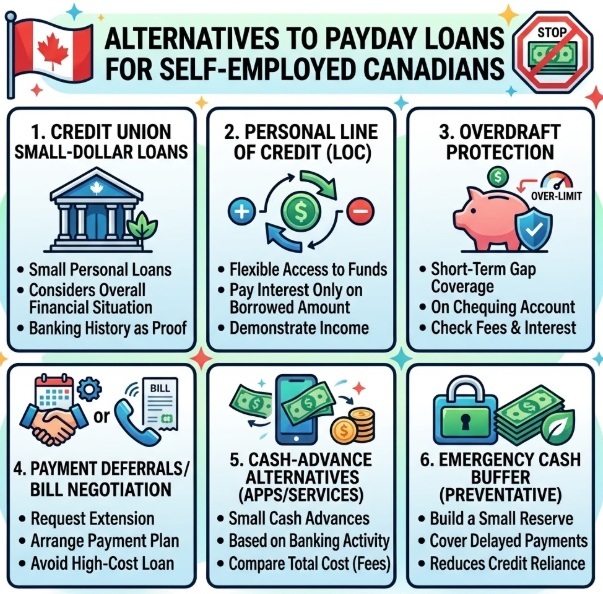
Payment Deferrals or Negotiating Bills
If you need a payday loan to cover a specific bill, contact the service provider or creditor before borrowing. You may be able to request a payment extension, change your payment date, or arrange a payment plan. Avoiding a high-cost loan can be particularly useful when you know when your next client payment will arrive.
Cash-Advance Alternatives
Some financial services offer small cash advances based on banking activity rather than traditional employment. Fees, subscription charges, eligibility requirements, and borrowing limits vary significantly, so compare the total cost before accepting an advance.
Build an Emergency Cash Buffer
For freelancers and other self-employed workers with variable income, maintaining an emergency fund can help reduce reliance on high-cost short-term credit. Even a small reserve can help cover recurring expenses during periods when client payments are delayed.
Bottom line: Before applying for a payday loan, compare the total cost of borrowing and consider whether a credit union loan, line of credit, overdraft protection, payment arrangement, or other lower-cost option could cover the same short-term need. Requirements vary, so make sure you understand the fees, interest rate, repayment schedule, and consequences of missed payments before accepting any loan.
Table 3: Best Payday loans for Self-Employed in Canada
|
Lender |
Loan Amount |
Loan Term |
Minimum Income Requirement |
Funding Speed |
|
Loan Express |
$100–$1,500 |
Up to 62 days |
Steady deposit history |
e-Transfer (as little as 2 mins) |
|
iCash |
$100–$1,500 |
7–62 days |
$800 / month |
e-Transfer (within minutes) |
|
Money Mart |
$100–$1,500 |
1–62 days |
Varies by applicant |
e-Transfer (from 15 mins) or Cash in-store |
|
My Canada Payday |
$100–$1,500 |
Up to 62 days |
Steady deposit history |
e-Transfer (15 - 30 mins) |
|
GoDay |
$100–$1,500 |
Up to 62 days |
Steady deposit history |
e-Transfer (within 1 hour) |
|
PAY2DAY |
$300–$1,500 |
Up to 62 days |
Steady deposit history |
e-Transfer (1 - 2 hours) |
Pro-Tip from Olesya Krasavtseva, Content Editor at Prostobank Consulting: "Because payday loans carry effective interest rates exceeding 300%, they should be your absolute last resort. If you have consistent self-employment income, establish a relationship with a local credit union now—before you face a cash crunch. A small-dollar line of credit secured in advance will save you hundreds of dollars in emergency borrowing fees."
Frequently asked questions
Can I get a payday loan with no T4?
Yes. Not having a T4 does not automatically prevent you from applying for a payday loan. Self-employed borrowers may be able to verify income using bank statements, a CRA Notice of Assessment (NOA), Form T2125, or bank-account verification. However, each lender has its own documentation requirements.
Can I get a payday loan if I am a freelancer in Canada?
Yes, freelancers may qualify for a payday loan in Canada if they meet the lender’s eligibility requirements. Because freelancers may not receive regular T4 employment income, lenders may use recent bank statements, transaction history, or other documentation to verify income and repayment ability. Requirements vary by lender and province.
Can gig workers (Uber, SkipTheDishes) get a payday loan in Canada?
Yes, gig workers can qualify for short-term loans. Since gig economy contractors do not receive traditional T4 pay stubs, lenders evaluate applications based on cash flow. You will typically need to use Instant Bank Verification (IBV) or provide 60 to 90 days of bank statements to prove consistent income deposits directly from platforms like Uber, SkipTheDishes, or DoorDash.
For some lenders, minimum monthly income requirements may fall within the $800–$1,200 range, but requirements vary by lender and province.
Do Canadian payday lenders require a minimum credit score for self-employed applicants?
Most Canadian payday lenders do not require a minimum credit score and often do not perform a hard credit check with Equifax or TransUnion. Instead of relying on your credit history, they assess your capacity to repay by analyzing your active bank account and the consistency of your business or gig income deposits.
What happens if a self-employed borrower defaults on a Canadian payday loan?
In Ontario, for example, default interest is capped at 2.5% per month, non-compounding, on the outstanding principal. Rules vary by province. The lender can send your account to a collection agency, which will negatively impact your credit report. Under Canadian consumer protection laws, a payday lender cannot automatically take money directly from your earnings through a "voluntary wage assignment". However, if they take you to Small Claims Court and win, they can obtain a court order to seize funds directly from your bank accounts or intercept payments owed to you by clients.
Can I get a payday loan in Quebec if I am self-employed?
It may be difficult to obtain a traditional payday loan in Quebec because lenders must comply with Quebec's consumer-protection rules. A lender may be refused a permit if its credit rate exceeds 35%. Self-employed borrowers should check the lender's current licensing status and consider lower-cost alternatives such as a credit union loan or authorized overdraft protection.
Can I get a payday loan with bad credit if I am self-employed?
Possibly. Some payday lenders place less emphasis on credit scores than traditional lenders and may focus more on your current income, banking activity, and ability to repay. However, bad credit does not guarantee approval, and eligibility criteria vary between lenders. Payday loans can also be significantly more expensive than other forms of borrowing.
What income counts as self-employment income for a payday loan?
Self-employment income can include money earned from freelance work, independent contracting, consulting, gig-economy platforms, online businesses, and other business activities. A lender may look at regular deposits from clients or platforms such as Uber, DoorDash, or other payment processors. Depending on the lender, you may need to provide bank statements, a CRA Notice of Assessment, Form T2125, or other documentation to verify your income.