
Securing financing for agricultural machinery—whether for a combine, tractor, or specialized processing equipment—requires navigating specialized lending criteria unique to the Canadian agricultural sector. Because farming is highly capital-intensive and subject to seasonal cash flow fluctuations, Canadian lenders offer specialized loan structures that differ significantly from standard commercial loans.
Primary Financing Options: Banks, FCC, and CALA
Before submitting an application, agribusinesses must determine the most appropriate lending channel. Canadian farm operations generally rely on three main avenues for equipment financing:
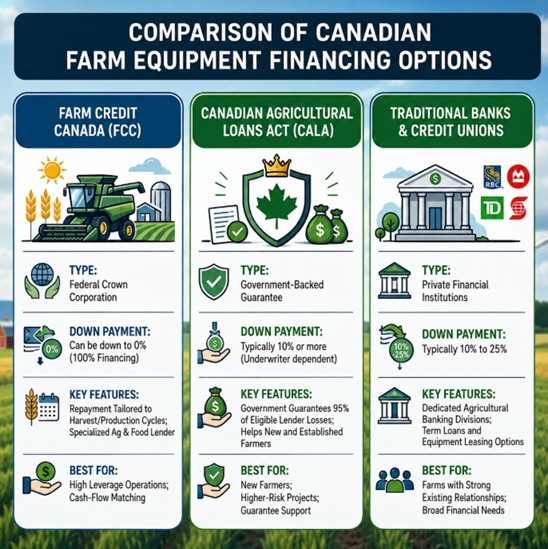
- Farm Credit Canada (FCC): As a federal Crown corporation, FCC specializes exclusively in agriculture and food lending. They often provide higher loan-to-value ratios (sometimes up to 100% financing) and offer repayment schedules tailored strictly to harvest or production cycles (e.g., annual or semi-annual payments).
- The Canadian Agricultural Loans Act (CALA) Program: This government-backed initiative helps farmers access credit by guaranteeing loans issued by financial institutions. Under CALA, established and new farmers can borrow up to $350,000 for farm implements and equipment (up to a maximum of $500,000 for all CALA loans combined). The Government of Canada guarantees up to 95% of a lender's eligible net loss on a registered CALA loan.
- Traditional Banks and Credit Unions: Canada’s major financial institutions (RBC, Scotiabank, BMO, CIBC, TD, and regional credit unions) have dedicated agricultural banking divisions. They provide competitive term loans and equipment leasing options, usually requiring a down payment of 10% to 25%.
Key Eligibility and Documentation Requirements
Approval depends on the lender's criteria, but agricultural lenders primarily evaluate historical cash flow, debt service coverage ratios, and the projected lifespan of the equipment.
To prepare a competitive application, assemble the following documents:
- Financial Statements: Notice to Reader, Review Engagement, or Audited financial statements for the past 2 to 3 years.
- Tax Documentation: T2 Corporate Tax Returns (for incorporated farms) or T1 General returns with Statement of Farming Activities (T2042) for sole proprietors/partnerships.
- Business Plan: Mandatory for new farmers or significant expansions. It must detail projected cash flow, crop yields, or livestock production.
- Equipment Details: The official dealer quote, including the purchase price, serial number, make, model, and expected useful life.
- Credit Profile: Both the business credit profile and the personal credit histories of the primary shareholders or partners.
- Other documents like 6–12 months bank statements, existing debt schedule, list of farm assets, land ownership/lease information, crop production history, livestock numbers where applicable, purchase agreement, insurance information, dealer invoices, proof of down payment.
Step-by-Step Application Process
- Assess Cash Flow Needs: Determine your optimal repayment schedule. If your revenue arrives primarily in October, request an annual payment structure aligned with your harvest rather than a standard monthly payment.
- Obtain the Dealer Quote: Secure a firm quote from the equipment dealer. Lenders cannot process an application without exact figures, including sales taxes (GST/HST/PST) and delivery fees.
- Compare Lenders: Approach your primary operating bank, but independently verify rates with FCC or a specialized equipment broker. If you are a new farmer with limited credit history, explicitly ask your lender to apply under the CALA program.
- Submit the Application: Provide the required documentation. Processing times vary by lender, loan size, documentation and borrower profile. Straightforward equipment applications may move relatively quickly, while larger or more complex transactions can take longer.
- Finalize the Security Agreement: The lender may register a security interest in the equipment. In most provinces this is handled through the provincial PPSA system, while Quebec uses the RDPRM for movable property security registrations.
Illustrative Example: Financing a Tractor
The advertised rate does not necessarily represent the lowest total cost. Consider the total interest paid over the life of the loan.
The following is an illustrative example of financing a new tractor through a traditional commercial agriculture loan, assuming standard monthly payments.
- Equipment Cost: $150,000
- Down Payment: $30,000 (20%)
- Amount Financed: $120,000
- Term & Amortization: 5 years (60 months)
- Annual Interest Rate: 7.50% (Fixed)
Based on these terms, the monthly payment would be approximately $2,404.55. Over the 5-year term, the total interest paid would amount to $24,273.12, making the total cost of the financed amount $144,273.12.
Key Takeaway: Always align your financing term with the realistic lifespan of the equipment. Financing a tractor over 10 years may lower payments, but it increases total interest costs and risks negative equity if the machinery needs early replacement.
Comparison of Canadian Farm Equipment Financing Options
|
Factor |
CALA Program (via Banks) |
Farm Credit Canada (FCC) |
Traditional Bank Ag-Loans |
|
Max Equipment Loan |
$350,000 |
Varies by operation |
Varies by operation |
|
Down Payment |
Up to 10% (often required) |
Up to 0% (100% financing possible) |
Typically 10% – 25% |
|
Repayment Flexibility |
Moderate |
High (Custom seasonal/harvest schedules) |
Moderate to High |
|
Best For... |
Beginning farmers, high-risk expansions |
Specialized operations requiring cash-flow matching |
Established farms with strong existing bank relationships |
Farm Equipment Loan vs. Equipment Leasing
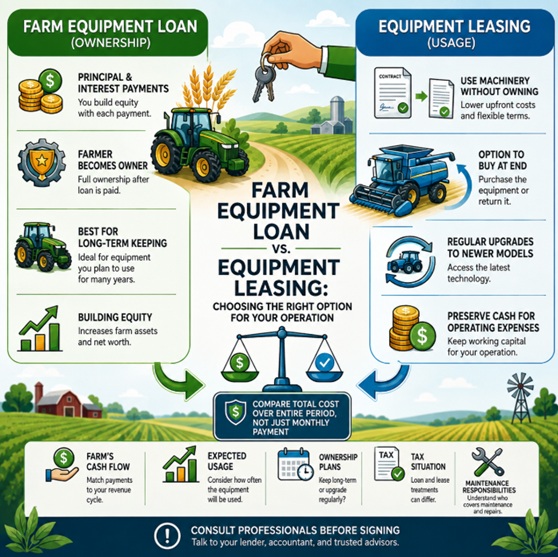
A farm equipment loan allows the farmer to purchase and own the machinery. The borrower normally makes scheduled principal and interest payments and becomes the owner of the equipment, subject to the lender's security interest until the loan is repaid. This option can be attractive for farmers who expect to keep a tractor, combine, or other machinery for many years.
Equipment leasing provides the farmer with the right to use the machinery for a specified period without necessarily owning it. Depending on the lease structure, the farmer may have an option to purchase the equipment at the end of the lease or return it and upgrade to newer machinery. Leasing can be useful for operations that regularly replace equipment or want to preserve cash for seasonal operating expenses.
The best option depends on the farm's cash flow, expected equipment usage, ownership plans, and tax situation. Compare the total cost over the entire financing or lease period rather than looking only at the monthly payment. Farmers should also ask about maintenance responsibilities, mileage or usage limits where applicable, end-of-term purchase options, early termination costs, and tax treatment before signing an agreement.
What Determines Your Farm Equipment Loan Rate?
The interest rate on a farm equipment loan in Canada depends on several factors related to both the borrower and the equipment being financed. Lenders typically review your credit history, farm revenue, existing debt, debt-service capacity, down payment, and overall financial position. A farm with stable cash flow and a strong credit profile may qualify for more competitive rates than a newer or higher-risk operation.
The type and condition of the equipment also matter. New tractors, combines, and other machinery may be easier to finance because they have predictable values and useful lives. Used equipment can have different financing terms depending on its age, condition, resale value, and remaining useful life. The loan term also affects pricing: longer repayment periods may reduce monthly payments but can result in a higher total interest cost.
Farmers should compare offers from FCC, banks, credit unions, and equipment dealers rather than focusing only on the advertised interest rate. Ask about the annual interest rate, fees, required down payment, repayment frequency, prepayment options, and total borrowing cost. Seasonal repayment options may also be important if most farm income is received during specific periods of the year.
Can You Finance Used Farm Equipment in Canada?
Yes. Farmers in Canada can finance used tractors, combines, harvesters, planting equipment, livestock equipment, and other agricultural machinery. Used equipment can be an attractive alternative to buying new machinery because the purchase price is usually lower and depreciation may already have occurred.
Lenders generally assess the equipment's age, condition, market value, expected useful life, and resale potential before approving financing. Financing terms for older machinery may be shorter than those available for new equipment. The lender may also require a dealer quote, equipment specifications, serial number, purchase agreement, or an independent appraisal, particularly when the equipment is being purchased from a private seller.
When comparing used farm equipment financing, consider more than the monthly payment. Check the equipment's maintenance history, remaining useful life, warranty coverage, and expected repair costs. A lower purchase price does not necessarily mean lower total ownership costs. Farmers should also compare a conventional equipment loan with dealer financing, FCC financing, and leasing to determine which option provides the best overall value.
Can a New Farmer Get an Equipment Loan in Canada?
Yes. Beginning farmers can qualify for farm equipment financing in Canada, although the application may require more detailed documentation because a new operation has limited financial and operating history. Lenders may place greater emphasis on the applicant's business plan, farming experience, personal credit history, available equity, projected revenue, and ability to make loan payments.
A strong business plan can significantly improve an application. It should explain the type of farming operation, expected production and revenue, operating expenses, equipment requirements, financing needs, and projected cash flow. Lenders may also want information about land ownership or leases, existing farm assets, previous agricultural experience, and the applicant's personal financial position.
Beginning farmers should consider multiple financing channels rather than relying on a single bank. The Canadian Agricultural Loans Act (CALA) program may provide financing through participating financial institutions for eligible beginning farmers, while FCC and commercial agricultural lenders may offer other specialized financing solutions. Approval is not automatic, however, and each lender still evaluates the applicant's ability to repay the financing.
Provincial Farm Equipment Financing Programs
Farmers may have access to provincial agricultural financing and support programs in addition to federal programs such as CALA and financing from Farm Credit Canada. The programs available can vary significantly between provinces and may change over time. Some may provide direct loans, loan guarantees, interest assistance, or targeted support for beginning farmers, farm expansion, modernization, or specific agricultural investments.
Before applying for equipment financing, farmers should check the agricultural ministry or relevant government agency in their province for current programs and eligibility requirements. Provincial programs may sometimes be combined with conventional financing, but the rules differ by program, so farmers should confirm whether other government assistance or lender financing affects eligibility.
It is also worth comparing provincial options with FCC, banks, credit unions, and equipment dealer financing. The most suitable solution depends on the equipment cost, farm size, available equity, credit profile, repayment capacity, and expected cash flow. Comparing the interest rate, fees, repayment schedule, security requirements, and total financing cost can help farmers choose the most cost-effective structure.
Frequently Asked Questions (FAQ)
What is the minimum down payment required for farm equipment loans in Canada?
The required down payment depends entirely on the lender and the borrower's risk profile. Traditional Canadian banks and credit unions typically require a down payment of 10% to 25% for farm machinery. However, specialized agricultural lenders like Farm Credit Canada (FCC) may offer up to 100% financing for qualified applicants, meaning no down payment is required. CALA financing can cover up to 80% of the eligible asset's value for existing farmers and up to 90% for beginning farmers, subject to the program rules and lender approval.
Can beginning farmers qualify for equipment financing through the CALA program?
Yes. The Canadian Agricultural Loans Act (CALA) program is specifically designed to support both established agribusinesses and beginning farmers. Because the Canadian government guarantees 95% of the loan amount, it significantly lowers the risk for financial institutions. This makes it much easier for new farmers with a limited credit history to secure equipment financing of up to $350,000 through their local bank or credit union.
How do seasonal repayment schedules work for Canadian agricultural loans?
Unlike standard commercial loans that require fixed monthly payments, specialized agricultural loans are designed around the realities of farming. Lenders like FCC and specialized bank ag-divisions allow you to align your loan payments with your revenue cycles. Instead of paying every month, you can arrange to make annual or semi-annual lump-sum payments directly following your harvest or primary production season, preventing cash flow shortages during the off-season.
Are interest payments on farm equipment tax-deductible in Canada?
Generally, yes. According to the Canada Revenue Agency (CRA), the interest paid on a loan used to purchase equipment for your farming business is tax-deductible as a business expense. Furthermore, the cost of the machinery itself can be depreciated over time using the Capital Cost Allowance (CCA). Agribusiness owners should consult a designated Canadian tax professional to ensure proper reporting on their T2 Corporate Tax Returns or T1 General (T2042) forms.
Can I Get a Farm Equipment Loan With Bad Credit?
Yes, it may still be possible to get farm equipment financing with bad credit, although approval may be more difficult and borrowing costs may be higher. Lenders can consider factors beyond your credit score, including farm revenue, cash flow, existing debt, available equity, collateral, and the value of the equipment. A larger down payment, additional collateral, and strong financial documentation may improve your application. If a traditional bank declines the application, compare FCC, credit unions, dealer financing, and other agricultural lenders. Always compare the total borrowing cost before accepting a high-cost loan.
What Credit Score Do I Need for a Farm Equipment Loan?
There is no universal minimum credit score for farm equipment loans in Canada. Each lender uses its own criteria and may consider your payment history, existing debt, farm income, cash flow, assets, down payment, and ability to service the new loan. Rather than focusing on a specific score, improve your overall credit profile before applying. Paying debts on time, reducing revolving balances, correcting credit-report errors, and avoiding unnecessary new borrowing can strengthen your application and potentially improve financing terms.