
The best business trust accounts in Canada are offered by major financial institutions like RBC, Scotiabank, and regional credit unions such as Vancity. These accounts are specifically engineered to meet the strict compliance requirements of provincial law societies and real estate councils. When comparing trust accounts, the key factor to evaluate is not just the monthly fee, but the bank's ability to manage sub-ledgers, integrate with trust accounting software, and simplify Canada Deposit Insurance Corporation (CDIC) beneficiary reporting.
How Canadian Trust Accounts Work
Trust account rules vary by province, profession and regulator. The two common structures discussed in Canada are pooled/mixed trust accounts and separate or designated accounts for individual clients.
Pooled Trust Accounts vs. Separate Interest-Bearing Accounts (SIBAs)
- Pooled Trust Accounts (General Trust): This is a single, aggregated account holding funds for multiple clients simultaneously. For legal professionals, these are often referred to as a mixed trust account. Under provincial regulations, the interest generated on these pooled accounts does not belong to the firm or the client; banks automatically remit the interest to the provincial Law Foundation or Real Estate Council to fund legal aid and public initiatives.
- Separate Interest-Bearing Accounts (SIBAs): A SIBA may be appropriate when a significant amount is held for one client for an extended period and the client wants the funds to earn interest. Provincial rules and client instructions determine when it should be used.
Who Needs a Business Trust Account?
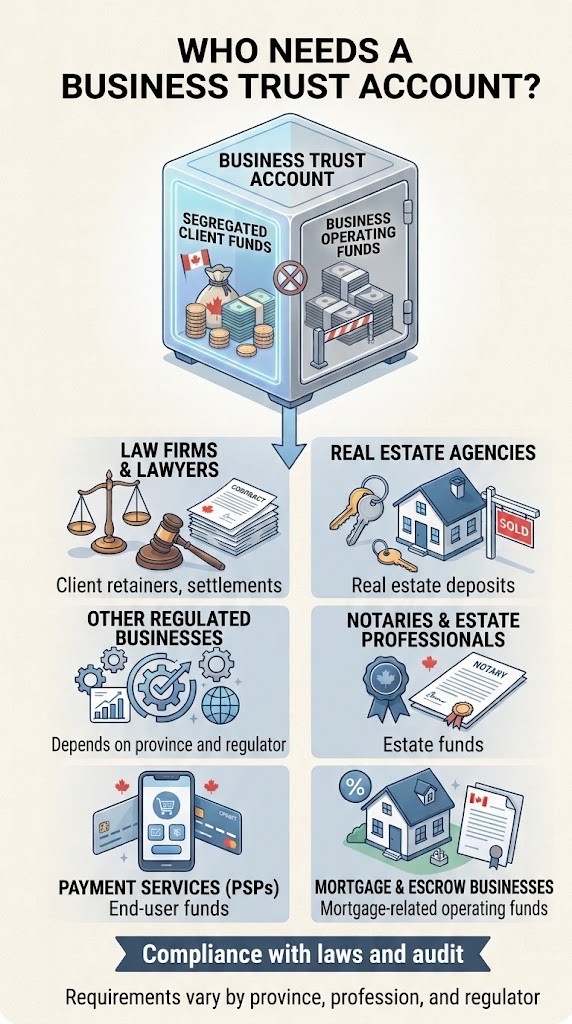
A business trust account is designed for businesses and professionals that hold money on behalf of clients or other beneficiaries rather than as their own operating funds. Keeping these funds separate helps meet legal, regulatory and accounting requirements.
Common users include:
- Law firms and lawyers — to hold client retainers, settlement proceeds, real estate deposits and other funds in trust.
- Real estate brokerages — to safeguard deposits and transaction funds received from buyers, sellers or other parties.
- Notaries and estate professionals — to manage client funds connected with property transactions, estates or other regulated activities.
- Mortgage and escrow businesses — where applicable provincial rules require client funds to be segregated from operating money.
- Payment Service Providers (PSPs) — registered PSPs may use trust accounts to safeguard end-user funds under Canada's retail payments framework.
- Other regulated businesses — depending on the province, profession and purpose of the funds, other businesses may also be required or permitted to use trust accounts.
The exact requirements vary by province, profession and regulator. Before opening an account, check whether your industry requires a pooled trust account, a separate client account, or another approved safeguarding structure.
How to Choose a Business Trust Account?
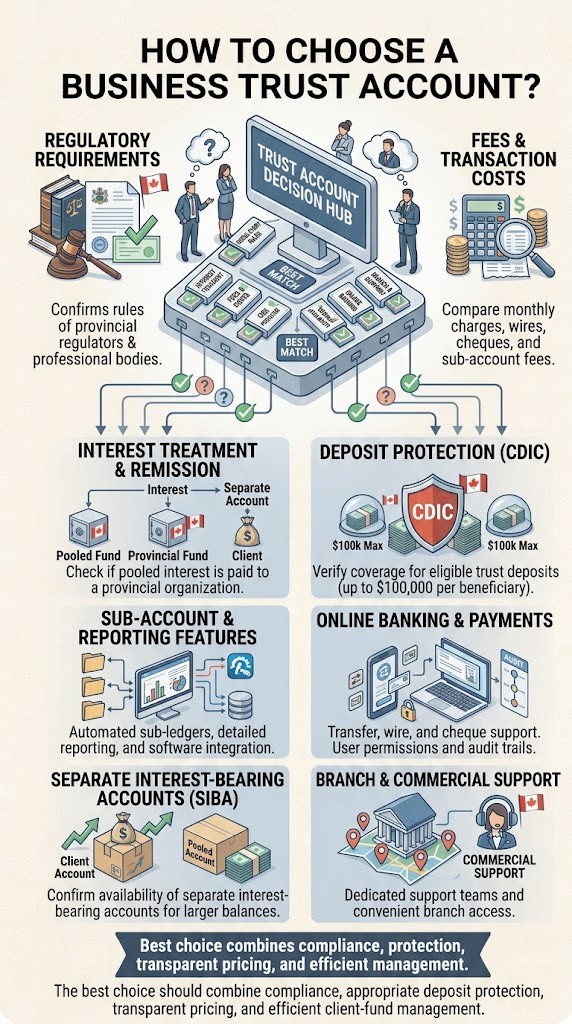
The best business trust account depends on how much client money you hold, how many beneficiaries you manage and how long the funds typically remain in the account. Compare these factors before choosing a bank or credit union:
- Regulatory requirements — Confirm that the account meets the rules of your provincial regulator and professional body. Requirements for lawyers, real estate professionals and PSPs can differ.
- Fees — Compare monthly charges, transaction fees, wire fees, cheque fees, sub-account charges and any SIBA setup or administration costs. A low monthly fee does not necessarily mean the account is the cheapest overall.
- Interest treatment — Check whether pooled-account interest is paid to a provincial organization and whether interest from a separate account can be credited to the individual client.
- CDIC or provincial deposit protection — If protection is important, verify whether the institution is a CDIC member or covered by a provincial deposit-insurance system. For eligible trust deposits, CDIC coverage can generally provide up to $100,000 per beneficiary when the applicable requirements are met.
- Sub-account and reporting features — Firms managing many clients should look for automated sub-ledgers, detailed transaction reporting, reconciliation tools and integrations with trust-accounting software.
- Online banking and payments — Check whether the account supports the transfers, wires, cheques and payment approvals your business needs, as well as suitable user permissions and audit trails.
- SIBA availability — If you regularly hold large balances for individual clients, confirm whether the institution offers separate interest-bearing accounts and understand the applicable rates and fees.
- Branch and support availability — Businesses handling high-value or regulated trust transactions may benefit from dedicated commercial support and convenient access to branches or specialized banking teams.
The best choice is therefore not necessarily the account with the lowest fee. A suitable trust account should combine regulatory compliance, appropriate deposit protection, transparent pricing and efficient client-fund management.
Top Trust Account Plans from Canadian Banks
The best business trust account depends on your profession, province, number of clients and how long you hold client funds. Several major Canadian banks offer dedicated trust-account solutions, while regional credit unions can be particularly attractive for lawyers, real estate professionals and notaries.
RBC Trusteed Deposit Service
RBC is a strong option for firms managing a high volume of trust funds. Its Trusteed Deposit Service is designed to help businesses manage multiple trust accounts and client balances through a centralized structure.
- Key Advantage: Suitable for firms that need organized management and reporting for numerous client trust balances.
- Consideration: Pricing and account arrangements may depend on the firm's banking relationship and transaction requirements.
Scotiabank Trust/Sub-Account Plan
Scotiabank's Trust/Sub-Account Plan is designed specifically for businesses that need to manage multiple trust accounts under one plan. It is available in CAD and USD, offers tiered interest based on the aggregate plan balance and has no setup, transaction or monthly maintenance fees according to Scotiabank. The plan is also eligible for CDIC insurance.
- Key Advantage: Multiple trust accounts can be managed under one structure with centralized administration.
- Consideration: The interest rate depends on the total balance held across the plan.
TD Trust Account
TD offers a dedicated Trust Account for businesses and organizations that hold funds on behalf of clients as part of their normal operations. TD identifies lawyers, real estate agents and accountants as typical users. The account can be supported by TD's commercial banking and cash-management services.
- Key Advantage: A dedicated trust-account solution from a major Canadian bank with commercial banking support.
- Consideration: Businesses should contact a TD Commercial Banking Relationship Manager for specific account terms and pricing.
National Bank Trust Accounts
National Bank provides trust-account services for professional users such as lawyers and notaries who handle funds for clients. Its business banking agreement also states that funds held in trust can only be maintained in an account that National Bank has expressly approved and identified as a trust account.
- Key Advantage: Established trust-account infrastructure and support for professional clients.
- Consideration: Account availability and requirements can depend on the business, profession and applicable provincial rules.
Vancity General Pooled Trust Account — British Columbia
For BC-based lawyers, realtors and notaries public, Vancity offers a specialized General Pooled Trust Account. The account is designed for deposits received from or on behalf of multiple clients and has no monthly fee for basic account transactions. Vancity states that deposits in the account are 100% protected by the Credit Union Deposit Insurance Corporation of British Columbia (CUDIC).
- Key Advantage: Strong fit for BC professionals seeking a dedicated pooled trust account with local support.
- Consideration: Vancity's availability is regional, so it may not be suitable for firms requiring a national branch network.
Which Trust Account Is Best?
For high-volume trust management, RBC and Scotiabank are worth comparing because of their specialized structures for managing multiple client balances. TD is another strong option for professional businesses that want a dedicated trust account combined with commercial banking services. National Bank can be particularly relevant to lawyers and notaries, while Vancity is a strong regional choice for eligible BC professionals.
Before choosing an account, compare fees, interest treatment, CDIC or provincial deposit protection, sub-account capabilities, reporting tools, transaction limits and provincial regulatory requirements rather than selecting a bank based only on its monthly fee.
Olesya Krasavtseva, Content Editor atProstobank Consulting
Pro tip: Don’t choose a business trust account based on monthly fees alone. For firms holding significant client balances, deposit protection, interest treatment, sub-account capabilities and reporting tools can have a much greater financial and operational impact. Also check whether your province or professional regulator has specific requirements before opening the account. For PSPs, make sure the trust structure meets the Bank of Canada’s current end-user funds safeguarding requirements.
Navigating CDIC Professional Trustee Rules
For professionals holding client funds, CDIC insurance is paramount. Under rules implemented by the Government of Canada in April 2022, CDIC covers eligible trust deposits up to $100,000 per beneficiary.
Professional Trustees can designate eligible accounts as Professional Trustee Accounts by providing an attestation and contact information to the CDIC member institution. They must maintain beneficiary records and provide the required information when requested by CDIC.
Break-Even Calculation: When to Open a SIBA
A common challenge for Canadian professionals is deciding whether a client's funds should remain in a pooled account or be moved to a SIBA. Because banks charge administration and setup fees for SIBAs, the interest earned must outweigh the cost.
Illustrative Example:
A lawyer is holding $150,000 for a commercial real estate transaction that has been delayed.
- SIBA Interest Rate: 3.50% annually
- Bank Setup/Admin Fee: $75.00
- Daily Interest Earned: $150,000 × 3.50% / 365 = $14.38 per day
The Break-Even Point:
$75.00 (Bank Fee) ÷ $14.38 (Daily Interest) = 5.2 days
- Decision: If the funds will be held for 6 days or longer, opening the SIBA generates a net positive financial return for the client. If the funds will be disbursed in under 5 days, keeping the money in the pooled trust account avoids unnecessary administrative friction and protects the client from taking a net loss on bank fees.
Trust Account Opening Checklist
Eligibility requirements vary by lender, but Canadian banks enforce strict Anti-Money Laundering (AML) and FINTRAC protocols for trust accounts. Before visiting the branch, ensure you have:
- Corporate registration documents (Articles of Incorporation or Partnership Agreement).
- A valid CRA Business Number.
- Proof of active standing with your provincial regulatory body (e.g., Law Society of Ontario, BCFSA, RECO).
- A formal letter of direction from your client (if opening a specific SIBA).
Pooled Trust Account VS Separate Interest-Bearing Account (SIBA)
|
Factor |
Pooled Trust Account (General) |
Separate Interest-Bearing Account (SIBA) |
|
Purpose |
Holds funds for multiple clients simultaneously. |
Holds funds for one specific client. |
|
Interest Beneficiary |
Remitted automatically to provincial Law Foundation / Real Estate Council. |
Accrued and paid directly to the specific client. |
|
Bank Fees |
Often waived or deducted from the interest before remission. |
Setup and administrative fees apply (charged to the client's balance). |
|
CDIC Protection |
Up to $100k per beneficiary (requires PTA attestation). |
Up to $100k for the named client beneficiary. |
|
Best Used For |
Short-term holds, real estate deposits, standard retainers. |
Large sums, delayed closings, long-term estate settlements. |
Frequently asked questions
Are business trust accounts covered by CDIC in Canada?
Yes. Eligible deposits held in trust at a CDIC member institution can receive up to $100,000 in CDIC protection per beneficiary, provided the trust and beneficiary information meet CDIC requirements. For professional trustees, including eligible PSPs, the Professional Trustee Account (PTA) framework can simplify beneficiary reporting.
CDIC protects the deposit if the financial institution fails, not if the business acting as trustee becomes insolvent.
What is the difference between a Pooled Trust Account and a SIBA?
A Pooled Trust Account holds funds belonging to multiple clients or beneficiaries in one account, with the trustee maintaining records showing each person's share.
A SIBA (Separate Interest-Bearing Trust Account) is established for one specific client and earns interest for that client. It is generally used when a substantial amount will be held for a longer period.
In simple terms: pooled account = multiple beneficiaries; SIBA = one client and interest earned for that client.
How does the CDIC Professional Trustee Account (PTA) framework work?
The PTA framework is designed for qualifying professional trustees. The trustee can have an account designated as a PTA by providing the required attestation to the CDIC member institution. Instead of routinely providing beneficiary information to the bank, the trustee maintains accurate records and supplies them to CDIC when requested.
The framework does not increase the insurance limit: eligible deposits remain protected up to $100,000 per beneficiary.
Can Payment Service Providers (PSPs) open trust accounts in Canada?
Yes. Under Canada's Retail Payment Activities Act (RPAA), PSPs that hold end-user funds can safeguard them through a trust account, keeping customer funds separate from the PSP's own money. Registered PSPs can also qualify as professional trustees under the CDIC framework.
Where all requirements are met, eligible funds held at a CDIC member institution may receive up to $100,000 in protection per beneficiary. CDIC protection covers the failure of the financial institution, not the PSP's own insolvency.
Do trust accounts earn interest in Canada?
Yes, but how interest is treated depends on the type of trust account and provincial rules. In Ontario, for example, interest earned on a pooled/mixed lawyer trust account is generally remitted to the Law Foundation of Ontario. A Separate Interest-Bearing Trust Account (SIBA) can be used for one client's funds, with the interest belonging to that client.
For large balances held for an extended period, professionals should check the applicable regulator's rules and discuss interest-bearing options with the client.
Are trust accounts different for lawyers and real estate brokers?
Yes. Trust-account requirements vary by profession, province and regulator. Lawyers are subject to professional trust-account rules covering client ledgers, reconciliations and, where applicable, SIBAs. Real estate professionals operate under separate provincial regulatory frameworks governing how deposits and other client funds must be held.
As a result, a trust account suitable for a law firm may not meet the requirements for a real estate brokerage. Businesses should confirm the specific rules of their provincial regulator before opening an account.
Does CDIC insurance apply separately to each trust beneficiary?
Yes. Eligible trust deposits at a CDIC member institution can receive up to $100,000 in coverage per beneficiary, provided the trustee meets the applicable disclosure requirements. CDIC aggregates deposits held for the same beneficiary at the same member institution when calculating coverage.
For example, if a properly documented trust holds $250,000 for two beneficiaries with equal interests, up to $200,000 may be insured—$100,000 for each beneficiary.
Can a trust account be opened online?
Sometimes, but not always. Trust accounts are subject to additional verification and regulatory requirements, so a bank may require documentation and review before opening the account. For example, the Law Society of Ontario notes that financial institutions may request proof of professional licensing when a lawyer or paralegal opens a trust account.
The exact process depends on the bank, province, profession and type of trust account. Contact the bank before applying online to confirm whether the specific trust account can be opened digitally or requires branch or commercial-banking assistance.