
A commercial vehicle loan operates similarly to a personal auto loan but is issued in the name of your registered Canadian business. The vehicle itself acts as collateral for the loan, which typically allows lenders to offer lower interest rates compared to unsecured business lines of credit.
How Commercial Vehicle Loans Work
Canadian lenders, credit unions, and specialized equipment financing companies offer commercial vehicle loans with terms ranging from 24 to 84 months. Lenders evaluate the financial health of the business, the type of vehicle being purchased, and the personal credit of the business owners. For most small to medium-sized enterprises (SMEs), lenders require a personal guarantee, meaning the owner is personally liable if the business defaults on the loan.
Sales taxes (GST, HST, or PST/QST depending on your province) apply to the purchase price of the vehicle. Many lenders allow businesses to roll these taxes into the total loan amount to preserve upfront cash flow, though businesses can later claim Input Tax Credits (ITCs) for the GST/HST paid on commercial vehicles.
Standard Business Auto vs. Heavy-Duty Truck Financing
Lenders view a florist’s delivery van and a logistics company’s Class 8 transport truck as two entirely different risk profiles.
|
Factor |
Light-Duty Commercial (Vans, Pickups, Cars) |
Heavy-Duty & Freight (Transport Trucks, Dump Trucks) |
|
Typical Lenders |
Big Five Banks, Dealerships, Credit Unions |
Specialized Equipment Lenders, BDC, Commercial Bank Divisions |
|
Down Payment |
0% – 10% |
10% – 20%+ |
|
Underwriting Focus |
General business cash flow and owner’s personal credit. |
The revenue-generating potential of the specific asset and fleet history. |
|
Term Limits |
Usually capped at 60–72 months. |
Can extend to 84 months due to longer asset lifespans. |
Business Vehicle & Truck Financing: Pros vs. Cons
Financing a business vehicle or commercial truck allows a Canadian business to acquire the vehicle without paying the full purchase price upfront. The vehicle typically serves as collateral for the loan, while the business repays the financing over an agreed term. However, commercial vehicle financing also creates a long-term financial obligation, so businesses should consider both the benefits and drawbacks before applying.
|
Pros |
Cons |
|
Preserves working capital: The business can keep cash available for payroll, inventory, fuel, maintenance, and other operating expenses. |
Interest costs: The total cost of the vehicle is higher than paying cash because the business pays interest and potentially financing fees. |
|
Vehicle ownership: With a traditional loan, the business builds equity in the vehicle and owns it once the financing is repaid. |
Monthly payment obligation: Payments must be made even when business revenue temporarily declines. |
|
Potential tax benefits: Qualifying interest, vehicle expenses, and CCA deductions may reduce taxable business income, subject to CRA rules. |
Collateral risk: The lender can generally take action against the financed vehicle if the borrower defaults. |
|
Builds business credit: Successfully managing commercial financing can help establish a stronger business credit history with some lenders. |
Personal guarantee: Small businesses and startups may be required to provide a personal guarantee, creating potential personal liability. |
|
Predictable budgeting: Fixed-rate financing can provide consistent monthly payments throughout the loan term. |
Depreciation: Commercial vehicles and trucks lose value over time, potentially leaving the business owing more than the vehicle is worth in some circumstances. |
|
Access to more expensive vehicles: Financing makes it possible to purchase trucks, vans, and specialized vehicles that may generate revenue for the business. |
Long-term commitment: A loan can last several years, limiting financial flexibility while the financing remains outstanding. |
Bottom Line
Business vehicle financing can be a practical option when the vehicle is essential to generating revenue and the business wants to preserve working capital. It can be particularly useful for trucks, delivery vans, and other commercial vehicles with a clear business purpose.
The main disadvantages are the interest cost, monthly repayment obligation, potential personal guarantee, and risk associated with using the vehicle as collateral. Before choosing financing, compare the interest rate, loan term, total cost of borrowing, down payment, and expected vehicle value.
Business Vehicle Loan vs Equipment Loan vs Business Line of Credit
Businesses have several ways to finance a commercial vehicle, but each option is designed for a different purpose.
|
Financing option |
Best for |
Main advantage |
Main limitation |
|
Business vehicle loan |
Buying cars, vans, pickups or trucks |
Structured payments and vehicle-specific financing |
Less flexible than a line of credit |
|
Equipment loan |
Heavy trucks and specialized commercial equipment |
Suitable for expensive revenue-generating assets |
May involve more detailed underwriting |
|
Business line of credit |
Short-term operating needs |
Flexible access to funds |
Usually not ideal for long-term vehicle purchases |
A business vehicle loan is usually the simplest option when the main goal is to purchase a commercial vehicle. The vehicle generally serves as collateral, and the business makes scheduled principal and interest payments.
An equipment loan may be more suitable for heavy-duty trucks, trailers, construction vehicles, or specialized equipment. The lender may place greater emphasis on the asset's value, useful life, and ability to generate revenue.
A business line of credit provides revolving access to funds and can be useful for fuel, repairs, payroll, inventory, or other short-term expenses. Using a line of credit to finance a vehicle over several years may be less appropriate because the interest rate can be variable and the facility is designed primarily for working capital.
For a long-term vehicle purchase, businesses will usually want to compare the total borrowing cost, repayment term, interest rate, collateral requirements, and impact on cash flow before choosing the financing structure.
Commercial Vehicle Lease vs Loan in Canada
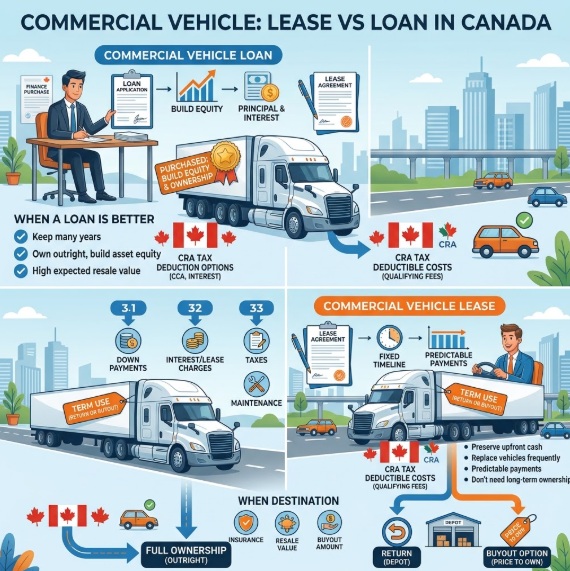
Businesses can either finance a commercial vehicle through a loan or lease it for a specified period. The better option depends on cash flow, how long the vehicle will be used, and whether the business wants to own the asset.
With a commercial vehicle loan, the business purchases the vehicle and repays the lender over an agreed term. Each payment generally includes principal and interest. As the principal is repaid, the business builds equity in the vehicle and ultimately owns it after the loan is paid off.
With a commercial vehicle lease, the business pays for the right to use the vehicle during the lease term. Depending on the agreement, the vehicle may be returned at the end of the lease or purchased for a specified amount.
Financing may be better when:
- You plan to keep the vehicle for many years.
- You want to own the truck outright.
- You want to build equity in the asset.
- The vehicle is expected to have useful resale value after the loan is repaid.
Leasing may be better when:
- You want to preserve upfront cash.
- You replace commercial vehicles frequently.
- You prefer predictable payments over a defined period.
- You do not necessarily want to own the vehicle long term.
The tax treatment is also different. For a purchased vehicle, businesses generally deal with the vehicle's capital cost, CCA, and potentially deductible interest. Qualifying lease costs may be deductible under applicable CRA rules and limitations.
The most important comparison is not simply the monthly payment. Businesses should calculate the total cost over the full term, including down payments, interest or lease charges, taxes, maintenance, insurance, expected resale value, and any amount required to purchase the vehicle at the end of a lease.
Current Canadian Loan Terms
To qualify for top-tier commercial financing, lenders generally require:
- Time in Business: Minimum 2 years of operating history (startups may require a co-signer or larger down payment).
- Financial Statements: Two years of Notice of Assessments (NOAs), T2 corporate tax returns, or accountant-prepared financial statements.
- Credit Score: A strong personal credit score (typically 680+) for the business owner providing the personal guarantee.
- Asset Details: The bill of sale, vehicle identification number (VIN), and proof of commercial auto insurance.
Best business loans for a vehicle purchase in Canada
|
Company – Program |
Loan Amount |
Loan Term |
Features |
|
TD Auto Finance – Small Business Vehicle Lending |
Up to $250,000 |
Up to 84 months |
Finance up to five new cars, vans or light-duty trucks; vehicles registered in the business name; available to sole proprietorships, corporations and partnerships; two years of financial statements may be required; personal covenant may apply. |
|
RBC Business Vehicle Solutions |
Up to $750,000 for dealer financing |
Up to 96 months |
Financing for most passenger cars and light-duty trucks; multiple-vehicle financing; upfit financing; weekly, bi-weekly, semi-monthly or monthly payments; no early repayment penalty; newer businesses may qualify with a co-signer. |
|
BMO Small Business Loan / Canada Small Business Financing Program |
Up to $500,000 for equipment and vehicles |
Up to 15 years under CSBFP |
Financing for equipment and vehicles; available to startups and established Canadian businesses with gross/projected revenue up to $10 million; government guarantee of up to 85%; up to six months of interest-only payments during the first year. |
|
Scotiabank Term Loan for Business |
Up to $1 million |
3–10 years for non-real-estate loans |
Designed for fixed-asset purchases, including business equipment; repayment can be aligned with the useful life of the asset; fixed or variable monthly payments. |
|
Scotiabank CSBFP Term Loan |
Up to $500,000 for equipment and leasehold improvements |
Up to 15 years |
Eligible purchases include vehicles for business purposes; available to startups and established businesses with revenue up to $10 million; financing up to 90% of eligible purchases; government guarantee up to 85%. |
|
CIBC Business Financing |
Varies |
Varies |
CIBC's business financing tools specifically allow businesses to identify “Buy a vehicle” as a borrowing purpose; financing amount and pricing depend on the business and application. |
|
National Bank Equipment Finance |
Not publicly disclosed |
Not publicly disclosed |
Equipment financing specifically serves the Transportation industry; businesses can choose a loan or lease; leasing typically requires no down payment; loans provide ownership, flexible payments and pre-approved financing options. |
|
BDC Equipment Loan |
Amount determined by application |
Up to 12 years |
Specifically covers commercial vehicles including trucks, trailers and specialized transport equipment; financing can reach up to 125% of equipment purchase price for eligible additional costs; payment schedules can be matched to cash flow; principal payments may be postponed for up to 24 months. |
CRA Tax Implications: CCA and Your Commercial Vehicle
When a Canadian business purchases a vehicle, it cannot deduct the entire purchase price in the first year. Instead, the Canada Revenue Agency (CRA) requires businesses to claim depreciation over time using the Capital Cost Allowance (CCA). The class of your vehicle determines your maximum annual deduction.
- Class 10 (30% rate): Covers standard delivery vans, pickup trucks, and passenger vehicles used purely for business.
- Class 10.1 (30% rate): Covers passenger vehicles that exceed the CRA's capital cost limit (which restricts the total depreciable amount for luxury or expensive passenger cars).
- Class 16 (40% rate): Covers heavy freight trucks, transport tractors, and commercial vehicles with a Gross Vehicle Weight Rating (GVWR) exceeding 11,788 kg. Because these vehicles depreciate faster through heavy use, the CRA allows a higher annual deduction.
Note: Interest paid on a commercial vehicle loan is also a tax-deductible business expense, subject to specific CRA daily limits for passenger vehicles.
Illustrative Example: Financing a $120,000 Freight Truck
To understand the total cost of borrowing, consider a logistics company in Ontario purchasing a heavy-duty truck. This calculation assumes the business finances the total cost after a 10% down payment, excluding HST (which the business pays upfront and claims as an ITC).
- Vehicle Price: $120,000
- Down Payment (10%): $12,000
- Amount Financed: $108,000
- Interest Rate: 7.50% (Fixed)
- Loan Term: 60 months (5 years)
|
Calculation Category |
Amount |
|
Monthly Payment |
$2,164.10 |
|
Total Payments (60 months) |
$129,846.00 |
|
Total Interest Paid |
$21,846.00 |
|
Total Acquisition Cost |
$141,846.00 |
This is an illustrative estimate. Actual rates and payments depend on lender underwriting, compounding frequency, and prevailing market conditions.
Strategic Advice Before Applying
- Do not rely solely on the dealership: Dealership financing is convenient but may include markup on the interest rate. Secure a pre-approval from your primary business bank or a specialized commercial equipment broker first to use as leverage.
- Separate personal and business assets: Ensure the loan is registered under your corporation (e.g., Ltd. or Inc.) rather than your personal name, even if a personal guarantee is required. This builds the company's commercial credit profile.
- Calculate the true cost of ownership: When budgeting for the monthly payment, factor in commercial fleet insurance and fuel costs, which are significantly higher than personal vehicle averages in Canada.
Pro Tip from Olesya Krasavtseva, Content Editor at Prostobank Consulting
“Don’t choose commercial vehicle financing based on the monthly payment alone. Compare the interest rate, total cost of borrowing, down payment, loan term, fees, and any personal guarantee requirements. For a new or growing business, preserving working capital can be just as important as getting the lowest possible rate.”
How to Apply for Commercial Vehicle Financing in Canada
Applying for commercial vehicle financing in Canada is similar to applying for a personal auto loan, but lenders typically require additional information about the business, its financial performance, and the vehicle being purchased. Banks, credit unions, dealerships, and specialized commercial equipment lenders may use different approval criteria, but the overall application process is generally similar.
Step 1: Choose the Vehicle You Want to Finance
Start by deciding what type of commercial vehicle your business needs, such as a car, pickup truck, cargo van, delivery vehicle, dump truck, semi-truck, or other heavy-duty commercial vehicle.
The lender may consider the vehicle's purchase price, age, mileage, condition, intended use, and expected resale value when determining whether to approve the financing.
For a new vehicle, you will normally receive a purchase order or bill of sale from the dealer. For a used vehicle, the lender may request additional information about the vehicle's history, condition, mileage, and seller.
Step 2: Check Your Business and Personal Credit
Before applying, review both the company's credit profile and the personal credit of the business owner or guarantor.
For small businesses, lenders often place significant weight on the owner's personal credit because the company may have limited borrowing history. A strong credit profile can improve your chances of approval and may help you qualify for more competitive financing terms.
Check for outstanding debts, late payments, collection accounts, or errors in your credit reports and resolve problems before submitting multiple financing applications.
Step 3: Prepare Your Business Documents
Commercial vehicle lenders typically require more documentation than a standard consumer auto lender. The exact requirements depend on the lender, the size of the loan, and the age and financial strength of the business.
Commonly requested documents may include:
- Business registration or incorporation documents
- Business Number (BN)
- Corporate tax returns, such as T2 returns
- Notices of Assessment (NOAs)
- Financial statements
- Recent business bank statements
- Information about existing business debts
- Government-issued identification for owners or directors
New businesses may have fewer financial records available. In that case, lenders may rely more heavily on the owner's personal credit, personal guarantee, business plan, projected cash flow, or down payment.
Step 4: Determine How Much You Can Afford
Before accepting financing, calculate the total monthly cost of operating the vehicle rather than focusing only on the loan payment.
Your budget should account for:
- Monthly loan payments
- Down payment
- Commercial vehicle insurance
- Fuel
- Maintenance and repairs
- Licensing and registration
- Tires and other operating costs
- Applicable sales taxes and fees
A lower monthly payment is not necessarily the cheapest option. Extending the loan term can reduce the monthly payment but may increase the total interest paid over the life of the loan.
Step 5: Compare Banks, Dealers and Equipment Finance Companies
Do not assume that the dealership's financing offer is automatically the best option.
Businesses can compare financing from several sources, including major Canadian banks, credit unions, dealership finance departments, specialized equipment finance companies, and other commercial lenders.
Compare the annual interest rate, loan term, required down payment, fees, prepayment conditions, and total cost of borrowing.
Obtaining a pre-approval before negotiating with a dealer can also give you a better understanding of your budget and provide a benchmark when reviewing the dealer's financing offer.
Step 6: Submit the Financing Application
Once you have selected a lender, you will generally submit an application containing information about both the business and the vehicle.
The lender may ask for:
- Legal business name
- Business structure
- Years in operation
- Annual revenue
- Existing debt obligations
- Owner or guarantor information
- Vehicle make, model and year
- Purchase price
- Vehicle Identification Number (VIN), when available
- Bill of sale or purchase agreement
- Commercial insurance information
For larger commercial trucks and specialized vehicles, the lender may also want information about how the asset will generate revenue for the business.
Step 7: Complete the Lender's Underwriting Process
After receiving the application, the lender reviews the business's financial position, credit history, repayment capacity, and the vehicle being financed.
Underwriting may consider:
- Business revenue and cash flow
- Profitability
- Time in business
- Personal and commercial credit history
- Existing borrowing
- Down payment
- Type and value of the vehicle
- Intended commercial use
- Personal guarantee or other security
A lender may ask for additional documents or clarification before making a final decision.
Step 8: Review the Financing Offer Carefully
If the application is approved, do not evaluate the offer based only on the advertised interest rate.
Review the full financing agreement and confirm:
- Interest rate
- Fixed or variable rate
- Loan amount
- Down payment
- Loan term
- Monthly payment
- Total amount payable
- Financing fees
- Prepayment options and penalties
- Security or collateral requirements
- Personal guarantee requirements
- Any insurance or administrative charges
Make sure the final financing terms match the terms you were quoted during the application process.
Step 9: Provide Insurance and Final Vehicle Documents
Before funding, the lender may require proof that the vehicle is properly insured for commercial use.
You may also need to provide the final bill of sale, registration information, VIN, purchase agreement, or other documents required by the lender.
For a financed commercial vehicle, the lender typically registers a security interest in the asset. This gives the lender rights over the vehicle if the borrower defaults on the loan.
Step 10: Complete the Purchase and Start Repayments
Once all conditions are satisfied, the lender releases the funds and the vehicle purchase can be completed.
Your repayment schedule then begins according to the financing agreement. Keep copies of the loan contract, purchase documents, insurance records, and payment history for your business records.
It is also important to maintain sufficient cash flow for the monthly payment and other operating costs throughout the life of the loan.
How Long Does Commercial Vehicle Financing Take in Canada?
The approval timeline varies significantly depending on the lender, business history, loan amount, and complexity of the vehicle purchase.
A straightforward application from an established business with strong credit and complete documentation may be processed relatively quickly. Applications involving a new business, weak credit, large commercial trucks, or additional underwriting requirements may take longer.
Preparing your financial statements, tax documents, identification, vehicle information, and insurance details in advance can help avoid unnecessary delays.
How to Improve Your Chances of Approval
Businesses can improve their chances of receiving commercial vehicle financing by maintaining strong personal and business credit, providing accurate financial records, reducing existing debt where possible, and making a reasonable down payment.
For a new business, a strong personal credit history and personal guarantee may be particularly important. Comparing multiple lenders before submitting an application can also help you find financing that better matches your company's financial position and the type of vehicle being purchased.
Used Commercial Truck Financing
Financing a used commercial truck can be a practical alternative to buying a new vehicle, especially when a business wants to reduce the upfront purchase price. Canadian lenders may finance used pickup trucks, cargo vans, dump trucks, transport trucks, semi-trucks, and other commercial vehicles, although eligibility requirements can be stricter than for new vehicles.
The age, mileage, condition, and market value of the truck are important factors. Some lenders impose maximum vehicle-age limits or offer shorter repayment terms for older vehicles. A used truck may also require a larger down payment or vehicle inspection before financing is approved.
The lender may request:
- Vehicle Identification Number (VIN)
- Bill of sale or purchase agreement
- Vehicle history report
- Mileage and maintenance records
- Independent inspection or appraisal
- Proof of commercial insurance
Financing a used truck from a dealership is often simpler because the dealer can provide the required documentation. Private-party purchases may also be eligible, but not every lender finances vehicles purchased from private sellers.
Before financing, calculate the total cost of ownership, including the loan payment, interest, insurance, fuel, maintenance, repairs, and potential downtime. A cheaper used truck is not necessarily more economical if it requires significant repairs shortly after purchase.
Bad Credit Commercial Truck Financing in Canada
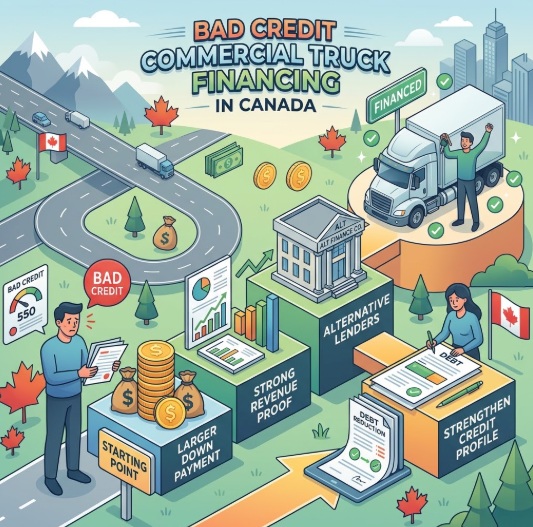
Businesses and owner-operators with bad credit may still qualify for commercial truck financing in Canada, but borrowing is generally more expensive and approval requirements can be stricter.
Lenders may consider both the owner's personal credit and the business's financial history. A low credit score can result in a higher interest rate, larger down payment, shorter loan term, or additional security requirements. A personal guarantee may also be required.
Businesses with weak credit may improve their chances by making a larger down payment, choosing a lower-priced vehicle, providing strong proof of revenue, or applying with a lender that specializes in alternative or commercial truck financing.
Before accepting a high-cost loan, compare the APR, total interest, fees, down payment, monthly payment, and total amount repayable. A lender that approves an application is not necessarily offering affordable financing.
It may also be worth taking steps to strengthen the credit profile before applying, such as reducing outstanding debt, correcting errors on credit reports, and maintaining consistent payments on existing obligations. For borrowers who have been declined by traditional banks, specialized commercial lenders and equipment finance companies may provide additional options, although their financing can carry higher costs.
Can a Sole Proprietor Get Commercial Vehicle Financing in Canada?
Yes. A sole proprietor can generally obtain commercial vehicle financing in Canada for a vehicle used to earn business income. However, the application is typically assessed based on the owner's personal financial position because a sole proprietorship is not a separate legal entity from its owner.
Lenders may consider the owner's personal credit score, income, business revenue, time in operation, existing debts, and the intended use of the vehicle. They may also request business registration documents, bank statements, tax documents, vehicle information, and proof of commercial insurance.
A sole proprietor may be able to finance cars, pickup trucks, vans, and heavier commercial vehicles, depending on the lender's policies. A personal guarantee is generally not a separate issue in the same way it is for a corporation because the sole proprietor is already personally responsible for the business's debts.
The tax treatment depends on the percentage of business use and the type of vehicle. Businesses should keep accurate records of business mileage and vehicle expenses to support any deductions claimed.
Frequently asked questions
Can a new business in Canada qualify for a commercial truck loan?
Yes. New businesses can qualify for commercial truck financing, but approval may be more difficult because they have limited business credit and financial history.
Lenders typically place greater emphasis on the owner's personal credit, income, down payment, and the expected ability of the business to repay the loan. A personal guarantee is commonly required, and startups may face higher down-payment requirements or interest rates.
Applicants should be prepared to provide business registration documents, personal and business financial information, vehicle details, and proof of commercial insurance. Comparing banks, credit unions, dealerships, and specialized equipment lenders can help startups find suitable financing.
Do I need a personal guarantee for a business vehicle loan in Canada?
For many small businesses and startups, a personal guarantee is common, although it is not required in every case.
A personal guarantee means the owner agrees to personally repay the debt if the business defaults. This is separate from the vehicle itself serving as collateral.
Guarantees are more likely when the business has limited credit history, a short operating history, low revenue, or insufficient assets. Established corporations with strong financials and substantial commercial credit may have more flexibility.
Before signing, review the guarantee carefully because it can create personal liability beyond the value of the financed vehicle.
Is it better to lease or finance a commercial truck in Canada?
Neither option is automatically better. The right choice depends on how long you plan to keep the truck, your cash-flow needs, and the total cost of ownership.
With financing, the business purchases the truck and builds equity as the loan principal is repaid. Once the loan is paid off, the company owns the vehicle.
With leasing, the business pays to use the truck for a specified period. Depending on the agreement, it may later return the vehicle, renew the lease, or purchase it.
Financing may be better for businesses planning to keep a truck long term, while leasing can be attractive for companies that want lower upfront costs or regularly replace vehicles. The tax treatment also differs: qualifying lease costs may be deductible under CRA rules, while financed vehicles generally involve separate treatment of interest and CCA.
Always compare total costs rather than just the monthly payment.
Can I write off my commercial vehicle loan payments on my taxes?
Generally, you cannot deduct the entire monthly truck loan payment as a business expense.
A loan payment consists of principal and interest. The interest portion may generally be deductible when the vehicle is used to earn business income, subject to CRA rules. The principal is not normally an immediate deduction; instead, the vehicle's capital cost may be claimed over time through Capital Cost Allowance (CCA).
For example, if a $2,500 payment contains $2,000 principal and $500 interest, the entire $2,500 is not normally deductible immediately.
The applicable CCA class depends on the vehicle. Certain trucks fall under Class 10, while qualifying heavy freight trucks can fall under Class 16.
What credit score is needed for a commercial vehicle loan?
There is no single minimum credit score used by every Canadian lender. However, a strong personal credit score can significantly improve the chances of approval and help the business qualify for more competitive rates.
For small businesses and startups, lenders may place considerable weight on the owner's personal credit because the company has limited commercial credit history. A lower score does not necessarily mean automatic rejection, but it may result in a higher interest rate, larger down payment, or additional security requirements.
Can I finance a truck with no money down?
Possibly. Some Canadian lenders may offer 0% down or very low-down-payment commercial vehicle financing to well-qualified borrowers, but it is not available in every situation.
The lender may consider the business's financial strength, personal and commercial credit, vehicle value, and operating history. A larger down payment can improve approval odds, reduce the amount financed, and lower total interest costs.
Even when no-down-payment financing is available, businesses should consider whether keeping more cash in the bank outweighs the higher monthly payment and borrowing cost.
How old can a commercial vehicle be?
There is no single maximum age that applies to every commercial vehicle loan in Canada. Each lender can set its own limits based on the vehicle's age, mileage, condition, type, and expected resale value.
Newer trucks generally provide more financing options and longer repayment terms. Older commercial vehicles may require a larger down payment, shorter loan term, inspection, or specialized financing.
Before applying, confirm the lender's maximum vehicle age and whether the limit is calculated from the model year or the date of financing.
Can I finance a truck from a private seller?
Yes, some Canadian lenders will finance commercial vehicles purchased from a private seller, but the process can be more restrictive than financing through a dealership.
The lender may require additional documentation, such as a bill of sale, vehicle identification number (VIN), ownership information, vehicle history report, and an independent inspection or appraisal. The truck must also meet the lender's age, condition, and value requirements.
Not every lender permits private-party commercial vehicle purchases, so confirm this before making a deposit or signing a purchase agreement.