
What is a Business Safety Deposit Box?
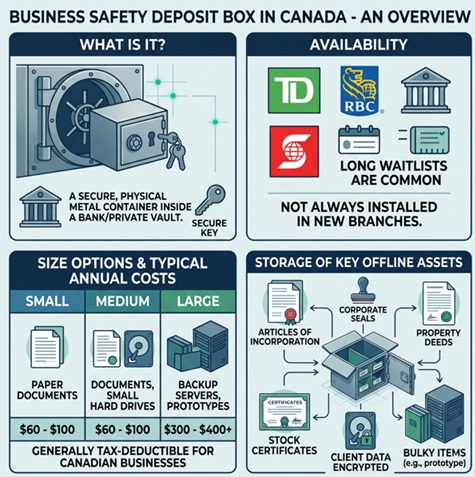
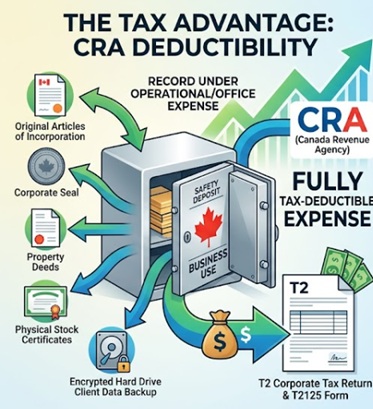
A business safety deposit box in Canada is a secure, physical metal container housed inside a bank or private facility's vault. Corporations and small businesses use these boxes to store critical offline assets, such as original articles of incorporation, corporate seals, property deeds, physical stock certificates, and encrypted hard drives containing client data backups. While rental fees vary by size, ranging from $60 to over $400 annually, they are generally a tax-deductible expense for CanadiaQn businesses.
Annual Costs and Size Options at Canadian Banks
Canadian financial institutions typically offer safety deposit boxes in standard dimensions, measured in inches. Availability is the primary hurdle; many "Big Five" banks (RBC, TD, Scotiabank, BMO, CIBC) and larger credit unions (such as Vancity or Meridian) have long waitlists and are not installing vaults in newly constructed branches.
When a box is available, the cost depends entirely on volume. Smaller boxes are designed for paper documents, while larger boxes are necessary for bulky items like backup servers or product prototypes. Fees are typically billed annually and automatically deducted from the linked business operating account.
Managing Corporate Access and Signing Authority
Unlike a personal safety deposit box, a business box requires formal corporate authorization. The individual opening the box cannot simply be an employee; they must be an authorized signor recognized by the bank.
To grant or change access, Canadian banks require:
- A formal corporate resolution or a signed business banking agreement.
- Updated signatures on the safety deposit box lease agreement.
- Verification of identity for all keyholders.
If an authorized employee leaves the company, the business must immediately notify the bank to revoke their access and physically retrieve or replace the keys. If both keys are lost, the bank must drill the lock, which typically incurs a penalty fee of $150 to $300, depending on the institution.
The Tax Advantage: CRA Deductibility
For Canadian businesses, renting a safety deposit box is not just a security measure; it is a recognized operational expense. According to the Canada Revenue Agency (CRA), if the box is used to store documents, assets, or data necessary for earning business or property income, the annual rental fee is fully tax-deductible. Businesses should record this under operational or office expenses on their T2 corporate tax return or T2125 form for sole proprietorships.
Insurance Limitations and CDIC Rules
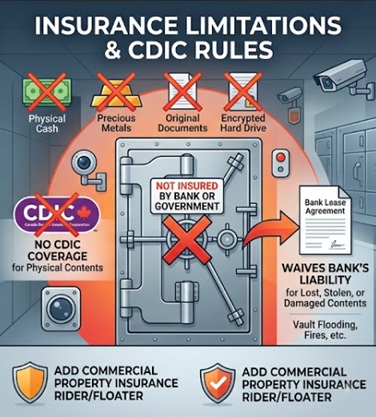
A common misconception among Canadian business owners is that items stored in a bank vault are insured by the bank or the government. They are not. The Canada Deposit Insurance Corporation (CDIC) only protects eligible deposits held in Canadian currency accounts up to $100,000. CDIC does not cover physical cash, precious metals, or documents stored in a safety deposit box. Furthermore, standard bank lease agreements explicitly waive the bank's liability for lost, stolen, or damaged contents (including damage from vault floods or fires). To protect physical assets, businesses must add a specific rider or floater to their commercial property insurance policy.
Bank Vaults vs. Private Security Facilities
Because Canadian banks are phasing out vaults, businesses requiring immediate secure storage are increasingly turning to private vault facilities (such as those operated by Brink’s or specialized private security firms in major cities like Toronto, Vancouver, and Montreal).
Key Considerations for Businesses:
Before accepting a bank's offer or joining a waitlist, compare the traditional bank option with a private facility. Private vaults often charge higher premiums (sometimes starting at $200+ annually) but offer superior availability, 24/7 access (whereas banks are limited to branch hours), and independent insurance options included in the rental cost.
Table: Estimated Annual Costs for Canadian Business Safety Deposit Boxes
The following table compares the annual rental fees for the most common box sizes across the "Big Five" and National Bank.
|
Bank |
Small (Approx. 1.5"x5") |
Medium (Approx. 3"x5" to 5"x5") |
Large (Approx. 5"x10") |
Notable Discounts |
|
RBC |
$60.00 |
$110.00 |
$350.00 |
$60 rebate for VIP Banking |
|
CIBC |
$80.00 |
$135.00 |
$250.00 |
Varies by banking centre |
|
BMO |
$70.00 |
$110.00 |
$230.00 |
Discounts for Premium/Seniors |
|
Scotiabank |
$80.00 |
$120.00 - $200.00 |
$350.00 |
Tied to account type |
All prices are subject to applicable taxes (GST/HST/QST). Drilling and key replacement fees are extra.
How to Open a Business Safety Deposit Box in Canada?
Opening a business safety deposit box in Canada is usually a branch-based process because the bank must verify the company, its authorized representatives and the individuals who will have access to the box. The exact requirements vary by financial institution and branch, and availability can be more important than the application itself.
Step 1: Check Availability at the Branch
Before preparing the paperwork, contact the bank or branch where you want to rent the box. Safety deposit boxes are not available at every location, and some branches may have only a limited number of boxes or may not accept new rentals.
Ask the branch to confirm:
- Whether business safety deposit boxes are available
- Which box sizes are currently available
- The annual rental fee and applicable taxes
- Whether the business must already have an account with the bank
- Which corporate documents are required
- Who can be registered as an authorized keyholder
If a suitable box is available, the bank can usually schedule an appointment for the application and identity verification.
Step 2: Prepare the Company's Documents
A corporation should be prepared to provide documents proving its legal existence and identifying the people authorized to act for the company. Requirements vary by bank, but commonly requested documents include:
- Articles of Incorporation or Certificate of Incorporation
- Current corporate profile or a similar government-issued record
- Information identifying the company's directors and officers
- Corporate resolution or banking resolution confirming signing authority, where required
- Business registration or trade-name documentation, if applicable
- Government-issued identification for directors, officers or authorized signers
- Additional proof of the company's current status, depending on how long it has been operating
For example, CIBC lists Articles of Incorporation, a recent filing showing directors and corporate records relating to the corporation's authority to bind the company among its requirements for corporate banking relationships. RBC and BMO likewise require corporate documentation and identification for relevant directors, officers or authorized signers.
Step 3: Authorize the People Who Can Access the Box
The corporation should decide who will be registered as a keyholder or authorized representative before the box is opened.
The bank will normally need to verify the identity of each person who receives access rights. The company should also make sure its internal corporate authorization matches the instructions given to the bank.
This is particularly important when several employees or officers need access. If an authorized person leaves the company, the business should promptly contact the bank and update the access arrangements.
Step 4: Complete the Safety Deposit Box Agreement
Once the bank approves the application and a box is available, the authorized representative signs the safety deposit box agreement and pays the applicable rental fee.
The agreement normally sets out matters such as:
- Annual rental charges
- Access rules and permitted keyholders
- Lost-key or drilling charges
- Conditions for terminating the rental
- Bank liability limitations
- Procedures for changing authorized access
The business should review these terms carefully, particularly the provisions dealing with insurance and the bank's liability for the contents of the box.
Step 5: Receive the Keys and Access the Box
After the agreement is completed, the bank provides the required keys or access credentials according to its procedures. The business representative can then access the box in the bank's designated private area.
The company should keep the keys securely and maintain an internal record of who is authorized to access the box. Losing the keys can result in additional charges because the bank may need to drill and replace the lock.
Frequently asked questions:
Can the CRA access a business safety deposit box during an audit?
During a standard civil tax audit, the Canada Revenue Agency (CRA) cannot arbitrarily force a bank to open your safety deposit box. However, under the Income Tax Act, the CRA has the authority to request that the authorized corporate signor open the box so an auditor can view and scan the contents. If the business refuses, or if the CRA's inquiry shifts into a criminal tax evasion investigation, the agency can obtain a formal search warrant to forcibly drill the box and seize its contents as evidence.
Are Canadian banks getting rid of safety deposit boxes?
Yes, there is an industry-wide trend of phasing out physical safety deposit boxes in Canada. In November 2023, National Bank became the first major Canadian bank to stop offering new safety deposit boxes. Existing customers were allowed to keep their boxes. While the "Big Five" banks (TD, RBC, BMO, Scotiabank, CIBC) still service existing boxes, many of their newly constructed branches are being designed entirely without vaults. The shift is driven by the rise of digital asset storage, high real estate costs, and the liability associated with maintaining physical security.
Can a business store physical cash in a safety deposit box?
While it is not strictly illegal under Canadian federal law, storing physical currency violates the standard Terms and Conditions of almost all major Canadian financial institutions. If a bank discovers that a business is using a safety deposit box to stockpile cash, the bank has the contractual right to terminate the lease immediately. Furthermore, cash stored inside a physical box is completely uninsurable and is not protected by the Canada Deposit Insurance Corporation (CDIC).
What happens to a corporate safety deposit box if the business goes bankrupt?
When a Canadian corporation files for bankruptcy, all company assets fall under the jurisdiction of the Bankruptcy and Insolvency Act. A Licensed Insolvency Trustee (LIT) is appointed to manage the insolvency. The trustee will legally take over the corporate banking profile, which includes notifying the bank to freeze the safety deposit box. The LIT will then take possession of the keys, inventory the contents of the box, and seize any physical assets of value to be liquidated and distributed to the company's creditors.