A commercial overdraft is a revolving credit facility attached directly to a Canadian business chequing account. It allows a company to process transactions—such as payroll, vendor payments, or automatic withdrawals—even when the account balance drops below zero, up to a pre-approved limit.
Unlike traditional loans, overdrafts are designed strictly for short-term liquidity, serving as a safety net against cash flow gaps and expensive non-sufficient funds (NSF) penalties.
How Business Overdrafts Work in Canada
When a business transaction exceeds the available cash in the operating account, the bank automatically covers the difference using the overdraft facility. The account balance will display as a negative figure. As soon as new receivables or deposits clear the account, the negative balance is paid down automatically.
Cost Structure: Interest Rates and Standby Fees
The cost of a commercial overdraft in Canada consists of two primary components:
- Interest Rates: Interest is typically floating and tied to the bank's Prime Rate. A standard business overdraft might be priced at Prime + 2% to Prime + 5%, depending on the company’s creditworthiness and whether the facility is secured.
- Monthly or Annual Fees: Canadian lenders generally charge a fee to keep the facility available, regardless of usage. For small limits (under $10,000), this is often a flat monthly fee of $5 to $15. For larger corporate limits, banks may charge an annual review fee, typically calculated as 1% to 1.5% of the total approved limit.
Example: Calculating Daily Overdraft Interest
The advertised rate does not necessarily represent the total cost because overdraft interest is calculated on the daily closing balance.
Illustrative example based on typical Canadian banking terms:
- Approved Overdraft Limit: $10,000
- Amount Overdrawn: $4,000
- Duration Overdrawn: 6 days
- Interest Rate: 11.5% (Assumed Prime of 6.5% + 5%)
- Monthly Account Fee: $10.00
The Calculation:
- Annual Interest on $4,000 = $460.00
- Daily Interest Rate ($460 ÷ 365 days) = $1.26 per day
- Total Interest for 6 days = $7.56
- Total Cost for the Month (Interest + Fee): $17.56
This calculation highlights why overdrafts are cost-effective for bridging a few days between payroll and accounts receivable, but expensive if used as long-term debt.
Pro-Tip from Olesya Krasavtseva, Content Editor at Prostobank Consulting
"Many Canadian business owners treat their overdraft terms as non-negotiable, but this is a common misconception. If your business uses multiple services with the same financial institution - such as merchant processing, corporate credit cards, or payroll systems - you have significant leverage. During your annual account review, ask your commercial account manager to waive the monthly standby fee or reduce your Prime Rate premium.
Comparing Short-Term Commercial Financing Options
|
Factor |
Commercial Overdraft |
Business Line of Credit (BLOC) |
Business Credit Card |
|
Primary Use Case |
Emergency cash flow, avoiding NSF fees. |
Inventory purchases, seasonal cash flow gaps. |
T&E expenses, daily operational purchases. |
|
Access Mechanism |
Automatic (attached to chequing). |
Manual transfer required. |
Point of sale / online processing. |
|
Typical Limits |
$1,000 – $20,000 (unsecured). Limit varies significantly by lender and borrower. |
$10,000 – $250,000+. |
$2,000 – $50,000. |
|
Interest Calculation |
Accrues daily immediately upon use. |
Accrues daily upon transfer. |
21-day grace period. Purchase grace period may apply if the balance is paid in full; cash advances generally accrue interest immediately. |
|
Cost to Maintain |
Low monthly fee ($5-$15) or annual percentage. |
Often no monthly fee; setup/annual fees apply. |
Annual fee ($0 to $200+). |
When Should a Business Use an Overdraft?
A commercial overdraft is best suited for short-term cash flow gaps when a business expects incoming funds shortly but needs to make payments before those funds arrive. Because interest is generally charged only on the amount actually used, an overdraft can be a flexible way to cover temporary liquidity needs.
Common situations where a business may use an overdraft include:
- Payroll timing: Cover payroll when customer payments or other receivables are expected shortly after payday.
- Supplier payments: Pay invoices on time when accounts receivable have not yet been collected.
- Unexpected operating expenses: Handle temporary, unplanned expenses without disrupting normal business operations.
- Seasonal cash flow gaps: Maintain sufficient working capital during short periods when expenses are higher than incoming revenue.
- Avoiding declined transactions: Provide a temporary buffer for eligible payments and automatic withdrawals that could otherwise exceed the available account balance.
An overdraft is generally not suitable for long-term borrowing. Businesses that regularly remain overdrawn or need financing for inventory, equipment, expansion or ongoing operating expenses may be better served by a business line of credit or term loan.
Commercial Overdraft: Pros and Cons
|
Factor |
Pros |
Cons |
|
Access to funds |
Provides automatic access to short-term liquidity when the chequing account balance is insufficient. |
The approved limit may be relatively small compared with a business line of credit. |
|
Convenience |
Once approved and linked to the account, eligible transactions can generally be covered without manually transferring funds. |
The business must monitor the account to avoid exceeding the approved limit. |
|
Interest costs |
Interest is generally charged only on the amount actually borrowed and for the period it remains outstanding. |
Overdraft interest rates can be higher than rates available on some business lines of credit. |
|
Cash flow management |
Useful for bridging temporary gaps between expenses and incoming customer payments. |
Frequent or prolonged use may indicate a structural cash flow problem. |
|
Payment protection |
Can help prevent eligible transactions from being returned because of insufficient funds. |
Other account or overdraft fees may still apply. |
|
Flexibility |
Funds can be used for a variety of short-term business expenses. |
The lender may reduce, suspend or cancel the facility subject to the account agreement. |
|
Repayment |
New deposits can automatically reduce the outstanding overdraft balance. |
The facility may be repayable on demand, depending on the lender's terms. |
Bottom line: A commercial overdraft works best as a short-term liquidity buffer, not as a substitute for permanent working capital. If a business consistently relies on its overdraft to remain operational, it should consider whether a larger or longer-term financing solution is more appropriate.
Overdraft vs NSF Fees
A commercial overdraft and an NSF (non-sufficient funds) fee address the same underlying problem—a transaction that exceeds the available balance—but they work very differently.
With an approved overdraft, the bank may allow an eligible transaction to proceed by advancing funds up to the business's approved overdraft limit. The business then pays interest and any applicable overdraft fees on the amount used.
An NSF situation occurs when there are insufficient funds and the transaction is returned or declined rather than covered by available overdraft credit. The business may then face an NSF fee, in addition to potential late-payment charges, supplier penalties or other consequences.
|
Factor |
Commercial Overdraft |
NSF |
|
Purpose |
Provides temporary access to funds when the account balance is insufficient. |
Occurs when a transaction cannot be covered because sufficient funds are unavailable. |
|
Transaction outcome |
An eligible transaction may be processed within the approved limit. |
The transaction may be returned, declined or otherwise unpaid. |
|
Cost |
Usually includes interest on the amount borrowed and potentially other applicable fees. |
May involve an NSF fee and additional costs resulting from the failed payment. |
|
Credit facility |
Requires prior approval and an established overdraft limit. |
Does not provide a borrowing facility. |
|
Best use |
Short-term cash flow gaps when incoming funds are expected. |
Not a financing strategy; it is generally an outcome of insufficient available funds. |
|
Risk |
Repeated use can make borrowing costs accumulate. |
Repeated NSF transactions can disrupt supplier relationships and create additional fees. |
For a business with predictable short-term cash flow gaps, an overdraft can be more useful than allowing payments to be returned for insufficient funds. However, businesses should compare the interest and facility fees with potential NSF costs and review the specific terms of their bank account agreement before relying on overdraft protection.
Commercial Overdraft vs. Business Line of Credit (BLOC)
While both are revolving credit products, they function differently within Canadian commercial banking.
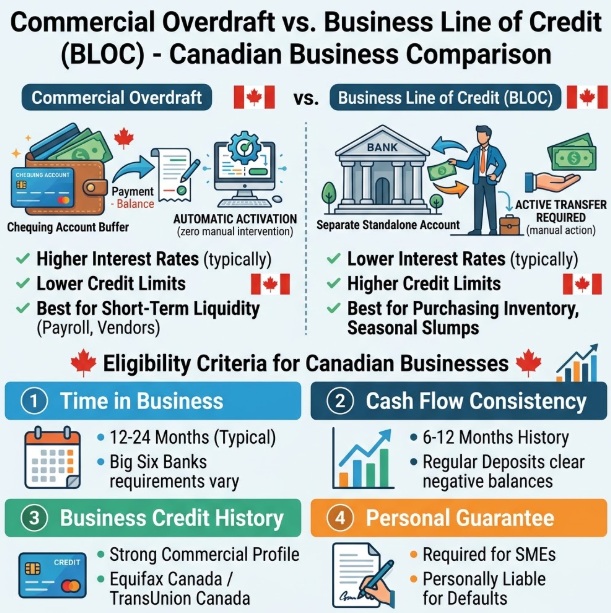
An overdraft acts as an automatic, invisible buffer on an existing chequing account. It requires zero manual intervention to activate. Once approved and linked to the operating account, the overdraft can generally be used automatically when eligible transactions exceed the available balance.
A Business Line of Credit (BLOC) is a separate, standalone account. To use a BLOC, the business owner or controller must actively transfer funds from the credit line into the operating account. BLOCs typically offer much higher limits and slightly lower interest rates, making them better suited for purchasing inventory or managing seasonal slumps.
Eligibility Criteria for Canadian Businesses
Approval depends on the lender's criteria, but Canadian financial institutions typically evaluate:
- Time in Business: Most Big Six banks require the business to have been operating for at least 12 to 24 months. Eligibility requirements vary by lender. Banks may consider the age of the business, revenue, cash flow, credit history, existing banking relationship and available security.
- Cash Flow Consistency: Lenders review 6 to 12 months of operating account history to ensure regular deposits can clear negative balances.
- Business Credit History: A strong commercial credit profile via Equifax Canada or TransUnion Canada.
- Personal Guarantee: For small to medium-sized enterprises (SMEs), banks almost universally require the business owners to sign a personal guarantee, making them personally liable if the business defaults.
Before accepting a commercial overdraft offer, businesses should compare the annualized cost of the facility against their historical NSF fees to determine if the monthly standby costs are justified.
How to Apply for a Commercial Overdraft in Canada
Most Canadian banks and credit unions offer commercial overdraft facilities as an add-on to a business chequing account. The application process is generally straightforward, but approval is subject to a credit assessment and a review of the business's financial position. Financial institutions typically evaluate cash flow, account history, creditworthiness and the business owner's ability to repay the facility.
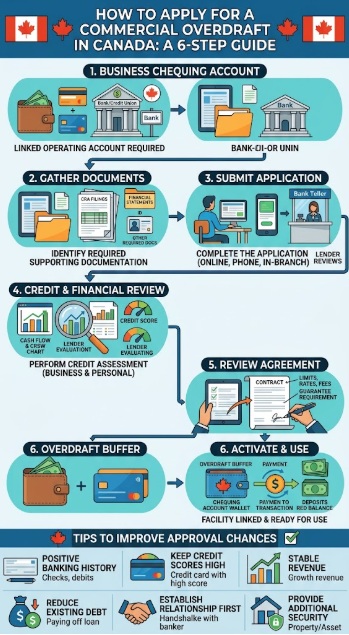
Step 1: Open or Maintain a Business Chequing Account
A commercial overdraft is normally linked directly to a business operating account. If your business does not already have a chequing account with the lender, you may need to open one before applying. Many banks also prefer to review several months of account activity before extending overdraft privileges.
Step 2: Gather Supporting Documentation
The lender may request documents that help verify the financial health of the business and the creditworthiness of its owners. Depending on the size of the overdraft and the lender's policies, you may be asked to provide:
- Business registration or incorporation documents
- Recent business financial statements
- Business bank account statements
- Canada Revenue Agency (CRA) filings or Notices of Assessment
- Identification for business owners and signing authorities
- Details of existing loans, credit facilities and liabilities
- A business plan for newer businesses, if applicable
- Personal financial information and guarantees from owners or directors
Step 3: Submit the Application
Applications can often be completed online, through mobile banking, by phone or at a branch, depending on the financial institution. The lender will typically review the business's banking relationship, revenue patterns, credit history and overall risk profile before making a decision.
Step 4: Complete the Credit Review
Because an overdraft is a form of credit, the lender will generally perform a credit assessment. Factors commonly considered include:
- Consistency of business cash flow
- Deposit history and account activity
- Existing debt obligations
- Business and personal credit history
- Length of the banking relationship
- Availability of security or personal guarantees, if required
Step 5: Review the Overdraft Agreement
Before accepting the facility, carefully review:
- Approved overdraft limit
- Interest rate and calculation method
- Monthly, annual or per-use fees
- Repayment requirements
- Conditions that may allow the lender to reduce or cancel the facility
- Personal guarantee obligations, if applicable
Financial institutions may reserve the right to change limits, decline transactions or cancel overdraft privileges under certain circumstances, so it is important to understand the account agreement before signing.
Step 6: Activate and Use the Facility
Once approved, the overdraft is linked to the business chequing account. If an eligible transaction exceeds the available balance, the account may automatically draw on the approved overdraft limit. Future deposits generally reduce the outstanding balance automatically, helping businesses manage temporary cash-flow shortages without transferring funds manually.
Tips to Improve Approval Chances
Businesses may improve their chances of approval by:
- Maintaining a positive banking history
- Keeping business and personal credit scores in good standing
- Demonstrating stable revenue and regular deposits
- Reducing existing debt where possible
- Establishing a banking relationship before applying
- Providing additional security if requested by the lender
Businesses with strong cash flow and a history of responsible account management are generally more likely to qualify for favourable overdraft limits and pricing.
Best Business Bank Accounts With Overdraft Protection in Canada
|
Company - account |
Monthly account fee |
Terms of overdraft |
Other features |
|
RBC Digital Choice Business Account |
$6 |
Royal Business Overdraft Protection available; terms and limits vary |
CAD-only account; unlimited electronic debit and credit transactions; unlimited Moneris and electronic cheque deposits; mobile banking; competitive FX rates |
|
Scotiabank Select Account for business |
$6 |
Overdraft protection available; credit limits of $500–$10,000; revolving credit; standard business overdraft rates apply (typically Prime + premium or 21% per annum) |
Designed for businesses with limited transactions; online and mobile banking; transaction-based pricing |
|
TD Everyday Business Plan A |
$19 |
Overdraft protection available; no monthly overdraft protection fee; no application fee |
20 included transactions; three business banking plans; monthly fee may be waived with minimum balance requirements |
|
BMO Everyday Business Account |
$22.50 |
Small Business Overdraft Protection available; fixed-fee or pay-per-use option |
Flexible overdraft protection; BMO Overdraft Transfer Service; 35 transactions; 2 Interac e-Transfers; Moneris transactions |
|
CIBC Advanced Business Operating Account |
$40 |
Overdraft protection available; $5,000 cash, 500 coin and 50 cheque deposits; secured protection may offer a lower rate; available in CAD and USD |
Up to 100 transactions; e-Transfers included; suitable for growing businesses; CAD/USD overdraft flexibility |
|
National Bank Premium Business Package |
$95 |
Business Overdraft Limit of $1,000–$10,000; automatic funds transfer when account balance is insufficient; $5 per overdraft transaction |
Unlimited electronic transactions and e-Transfers; 100 assisted transactions/month; monthly fee waived with $80,000+ balance |
Frequently asked questions
Can a new business in Canada qualify for a commercial overdraft?
It is difficult, but possible. Most major Canadian banks typically require a business to have 12 to 24 months of operating history and positive cash flow before approving an unsecured commercial overdraft. However, a startup or new business may still qualify if the business owner provides a strong personal guarantee, has an excellent personal credit score, or if the overdraft facility is fully secured by cash deposits or other tangible business assets.
Does using a commercial overdraft impact my business credit score?
Using an overdraft within the agreed terms does not necessarily result in a negative business credit event. However, reporting practices vary by lender. If an unpaid overdraft is sent to collections or results in a default, it can negatively affect the business's credit profile.Canadian credit bureaus, such as Equifax Canada and TransUnion Canada, do not usually treat chequing account overdrafts as standard reporting credit lines. However, if your account remains in a negative balance beyond the bank's allowed timeframe (often 60 to 90 days) and the account is closed and sent to collections, it will be reported to the bureaus and significantly damage your business credit rating.
Can a bank cancel my commercial overdraft without notice?
Yes. In Canadian commercial banking, an overdraft is legally structured as a "demand facility." This means the financial institution reserves the right to reduce your overdraft limit, cancel the facility entirely, or demand full and immediate repayment of the outstanding balance at any time, often without prior notice. Banks typically exercise this right if they detect a severe deterioration in your business cash flow, missed payments on other products, or a breach of the account agreement.
Are business overdraft fees tax-deductible in Canada?
Yes. Under Canada Revenue Agency (CRA) guidelines, both the monthly overdraft standby fees and the daily interest charged on the overdrawn balance are considered legitimate, tax-deductible business expenses. Interest and certain bank charges incurred to earn business income may generally be deductible, subject to CRA rules and the circumstances of the business.